Showing posts with label Seamus Heaney. Show all posts

Tuesday, September 22, 2020

A RARE BIRD SINGING IN MONAGHAN

This piece first appeared in Boston Irish Magazine, Volume 1, Number 3 (Autumn 2020), p. 15.

 Outside of the larger-than-life figure of Patrick Kavanagh (1904-1967), County Monaghan has produced only a handful of poets whose work is known and read widely. The most notable of these include Mary O’Donnell and Aidan Rooney. Also a prolific writer of novels and short stories, O’Donnell has published a half-dozen books of poems. Rooney, who teaches at Thayer Academy just south of Boston, has just published his third book, Go There, with Massachusetts-based MadHat Press.


Caitríona Ní Chléirchín is thus a rara avis in more ways than one. First of all, she is Monaghan born and bred. More precisely, she hails from Gortmoney, a townland of Emyvale, a village of about 700 residents located on the N2 about halfway between Monaghan Town and Aughnacloy, County Tyrone. The village’s previous claim to literary fame is as the setting for “The Fair of Emyvale,” a melodramatic short story published by Tyrone native William Carleton in The Illustrated London Magazine in 1853. (Carleton lived in the vicinity of Emyvale between 1814 and 1816. Residing with relatives in Derrygola in the parish of Donagh, he passed what he remembers as “the most delightful period of my youth” while attending a “classical school” conducted by his cousin in Glennon in the neighboring parish of Truagh.) Adding to those distinctions, Ní Chléirchín writes in Irish.


The author of two books of poems published as Gaeilge—Crithloinnir (2010) and An Bhrídeach Sí (2014)—she recently launched with The Gallery Press a facing-page dual-language volume, The Talk of the Town. Translated by Gallery publisher Peter Fallon, the thirty-five poem selection introduces to English-language readers a poetic voice that is both engaging and intriguing. As the title poem makes clear, Ní Chléirchín writes as a “millennial” woman. Titled “Corgarnach” in Irish, which means “whispering,” the poem laments the plight of a woman—everywoman—who is constantly being scrutinized, evaluated, objectified:


From time to time I just

get tired of being a woman,

the cuts to the chase I’ve to put

up with, and then inattention.


Made to feel self-conscious by the gaze of others (perhaps not just the male gaze), and by the whispering too, she becomes the object of even her own harsh judgment:


I’m tired of how my face

feels, and my fingertips,

my hair, my waist,

my very hips.


Yet Ní Chléirchín also shows how poetry with a contemporary sensibility can still stand on the shoulders of a long tradition of poetry written in Irish. That tradition includes dánta grádha—love poems—and there are love poems go leor in The Talk of the Town: poems of lost love and longing, of abandoned love and regret, of new love and of love renewed. Tellingly, the very titles of many of these poems resonate with the spirit of Douglas Hyde’s famous dual-language compilation of dánta grádha originally published in 1893, Love Songs of Connacht: “Drumshark (The Ridge of Love),” “My Man of the Sea,” “When You Go From Me,” “I Went Out to Find You.” Inevitably some of them even deploy tropes that recur in the poems translated by Hyde: in “Tar Liom, a Ghrá,” for example, translated as “Come Away with Me, Darling,” Ní Chléirchín locates the emotion of the poem in a bucolic landscape steeped deep in the pastoral romantic conventions of an earlier time:


Come away with me, darling,

out into the fields, into spring

pasture. We’ll make a reed bed

in a hollow and lie there a while

under a sky loud with birds’ singing.


In contrast, in “Taom”/“Swell” the speaker is unambiguously contemporary in her dismissal of a former love interest:


Don’t come within a mile

of me, nor lay 

a hand near me. Don’t say

a single word to me.

Don’t cry out.

Don’t even throw an eye my way.


Ní Chléirchín also includes several poems centered on the loss of her beloved mother, Vonnie. The most overt of these is “Capall Bán”/“The Old Grey Mare,” in which she engages myth in giving her dying mother permission to “cross / the threshold, for to cross / the threshold you’re fated”:


That’s the all of it, my dearest,

and the old grey will transport you well

when you go to those Elysian Fields

where a tear has yet to fall.


Her mother is also present in the six-poem sequence titled “Trasnú na Teorann”/“Border Crossing” which reflects the proximity of Emyvale to the border with Northern Ireland where she was born. Many readers will recognize the poet’s nod toward Seamus Heaney in Peter Fallon’s literal translation of the opening lines of the first poem: “Whatever you say / say . . .” Describing her mother as “a huddle of worry, a bundle of bother, / and struggling to banish the dread // of the ‘Big Shed’ at the border,” Ní Chléirchín expresses, like Heaney before her, the sense of personal violation that the checkpoint represents. For the poet and her family it is, moreover, a site of cultural violation: “That was no place for laughter, or Irish music or— / indeed—Irish itself. The sweetest sound was silence.”


In some ways stylistically anomalous in the overall collection, Ní Chléirchín’s poem remembering a ceremonial reading of poems at the grave of Patrick Kavanagh in Inniskeen actually invites the reader to pay heed to how so many poems in The Talk of the Town are, like Kavanagh’s, grounded in Monaghan, the “land of the little hills.” The Irish name for Emyvale is Scairbh na gCaorach; for Gortmoney it is Gort na Móna. Kavanagh once wrote: “Naming . . . is the love-act and its pledge.” In a single poem, Ní Chléirchín names—actually incants—townlands and villages and parishes intimately familiar to her as she searches for a lost love: Derrygassan, Derryshillagh, Derryhee, Dernashallog, Ternaneill, Blue Bridge, Ballyoisin, Inishdevlin, Donagh, Castle Leslie, Lisboy, Coracrin, Cornacrieve. The reader is with her every loving step of the way.


Not surprisingly, Ní Chléirchín’s writing in Irish has earned significant recognition: Crithloinnir won first prize in the Oireachtas competition for new writers in 2010, and An Bhrídeach Sí was joint winner of the prestigious Michael Hartnett Poetry Award in 2014. Affirming “a poet with a mature confident voice,” the judges’ citation for the Hartnett Award noted: “Her mastery of Irish and sense of being at home in both tradition and modernity is evident throughout the book, in poems set in the seventeenth century, poems framed by Gaelic mythology and in intensely personal lyrics. The poems are full of passion and also quiet reflection on life and love and death.” All of this rings true to the rich gathering of poems translated in The Talk of the Town.


Wednesday, July 1, 2020

AIDAN ROONEY IN A COUNTRY CHURCHYARD

This piece first appeared in Boston Irish Magazine, Volume 1, Number 2 (Summer 2020), p. 10.

In 1938, the year before he died, preeminent Irish poet William Butler Yeats spelled out in his valedictory poem “Under Ben Bulben” explicit instructions for the epitaph he wished to have cut into the slab of local limestone that would mark his grave:

Cast a cold eye
On life, on death.
Horseman, pass by.

Ironically, given that his intention was to turn on its head the Roman entreaty of Sta viator—“Halt, traveler”—commonly found on roadside graves in old Italy, Yeats’s stoic directive has become a summons to his legion of admiring readers and other literary tourists to do just the opposite of what he commanded. Located in Drumcliff churchyard in County Sligo, his grave is probably the most frequently visited in all of Ireland. A couple of years ago I made the pilgrimage there myself . . . and not for the first time.

Will the grave of Seamus Heaney, the only other Irish poet whose popularity and name recognition rival Yeats’s, likewise become a must-see tourist site?  Born in 1939, the year that Yeats died, Heaney emerged as a promising poet in the mid-1960s then rose to prominence in the 1970s and to fame in the ’80s.  In 1995 he was awarded, like Yeats before him, the Nobel Prize for literature, the judges honoring him for his “works of lyrical beauty and ethical depth, which exalt everyday miracles and the living past.”  He died in late August of 2013 and was buried in St. Mary’s Cemetery in his home village of Bellaghy in south County Derry.  Thanks to the opening in 2016 of The Homeplace, a former Royal Ulster Constabulary police station in Bellaghy converted into an arts centre dedicated to his writing and his life, Heaney’s final resting place may indeed become a destination.  I visited his grave in 2016 to pay my respects to a writer and a man whom I have admired greatly since first encountering his poetry in 1978, before he had become “famous Seamus.”

I was reminded of that visit recently when I read a particularly fine poem included in Go There (MadHat Press), a rich new volume by County Monaghan native Aidan Rooney.  The author of two previous books of poems, Day Release (2000) and Tightrope (2007), Rooney is a longtime resident of Massachusetts, where he teaches at Thayer Academy in Braintree.  An unabashed admirer of Heaney, Rooney not only traveled to Dublin for his funeral but also followed his funeral cortège northward to Bellaghy for his interment. His experience in the cemetery prompted a poem that he titled simply “In a Country Churchyard.”

For seasoned readers of poetry, that title will call to mind Thomas Gray’s iconic “Elegy Written in a Country Churchyard” from 1751, a somber meditation on human mortality.  “The curfew tolls the knell of parting day,” Gray intones in the opening stanza, “The lowing herd wind slowly o’er the lea, / The plowman homeward plods his weary way, / And leaves the world to darkness and to me.”  As Heaney’s friend and fellow Nobel Laureate Czesław Miłosz once wrote in a poem, “One clear stanza can take more weight / Than a whole wagon of elaborate prose.” Composed not in Gray’s precisely measured and strictly rhymed quatrains (32 of them, no less) but in four supple blank verse six-line stanzas, Rooney’s poem is likewise built to carry its thematic weight, and it is built to last.

While dedicated to the memory of Seamus Heaney, Rooney’s poem actually has at its focal center the aging unnamed gravedigger in St. Mary’s cemetery whose son, also a gravedigger, confides in the poet that Heaney’s burial will be his father’s last day on the job: “We want him to go out on a high note,” the son explains.  But this is unbeknownst to the father: “We haven’t told him yet, the son disclosed, / but will when all the fuss is over.”  The attuned reader might recognize that Rooney himself is recognizing common ground (as it were) between the recently deceased poet and the elder gravedigger. This is hinted at in the first stanza when, describing how the younger gravedigger stood with “his right foot on the left lug of a spade,” Rooney makes a deft allusion via that word “lug” to Heaney’s most famous poem, “Digging,” the first poem in his first volume of poems, Death of a Naturalist (1966).  In that poem of succession from father to son, Heaney remembers with a precise eye how adeptly his “old man” handled a spade to dig potatoes on the family farm: “The coarse boot nestled on the lug, the shaft / Against the inside of the knee was levered firmly.”  Rooney’s Heaney-esque deploying of the Ulster dialect word “fornenst” in the second stanza—in this context meaning “alongside” or “near”—offers another linguistic link between the poet and the senior gravedigger: “His father sat fornenst the opened plot, / on a stone wall the sun going down lit up.”

By the third stanza, Rooney becomes more explicit in equating the two men when, suddenly seeing the father from the perspective of the son who will carry on the family operation of helping to bury the dead, he casts the soon-to-be-retired gravedigger as a stand-in for Heaney:

His father’s hair, as the poet’s used to, glowed
in a sudden, sideways burst of sunshine.
Magnesium burning. And would not let up
no matter the light. Or the light dying.

To his credit, however, Rooney resists any temptation to follow Heaney’s lead, which famously involved transforming the farm implements of his forefathers—the spade for digging spuds, the sleán for cutting turf—into a metaphor: “Between my finger and my thumb / The squat pen rests. / I’ll dig with it.”  (Yeats used a similar trope in his poem “Pardon, old fathers,” apologizing that “I have nothing but a book, / Nothing but that to prove your blood and mine.”)

Rooney’s poem ends instead with a striking description of how the son fills in the poet’s grave by tipping from a mechanized digger’s bucket a load of shingle scooped and transported from Lough Neagh, which figures so prominently in Heaney’s poetry.  (Aptly, with a surface area of more than 150 square miles, Lough Neagh touches on five of the six counties of Heaney’s native Northern Ireland.)  The gravel cascading “like the wall of a waterfall,” the speaker in the poem—ostensibly Rooney himself—watches the son as “He watched his father through its thinning veil / get up to get the shovel and the rake.”  Still unaware that this will be his final burial, unaware of “the sun going down” on his undertaking, of “the light dying” on his shock of white hair, the older man persists, as did Heaney with his pen, in taking up the trusty tools of his trade.

In mid-August of 2015, a little less than two years after Seamus Heaney’s death, the wooden cross that temporarily marked his grave was replaced by a simple headstone of Kilkenny blue limestone inscribed with words from his poem “The Gravel Walks”: WALK ON AIR AGAINST YOUR BETTER JUDGEMENT.  Heaney once explained that line in an interview: “My poetry on the whole was earth-hugging, but then I began to look up rather than keep down.  I think it had to do with a sense that the marvellous was as permissible as the matter-of-fact in poetry.”  Less a directive than an invitation, his epitaph may prove as much of a summons to readers to visit Bellaghy as Yeats’s is to visit Drumcliff.  And a summons to visit his poetry as well.

Tuesday, March 1, 2011

DEEP IN THE HEART OF DERRY

This piece first appeared in The Boston Irish Reporter, Volume 22, Number 3 (March 2011), 30.

“The schoolmen were schoolboys first.” So James Joyce has Stephen Dedalus muse in the “Scylla and Charybdis” episode of Ulysses. These words would have made an apt epigraph for The Boys of St. Columb’s (The Liffey Press, 2010), Maurice Fitzpatrick’s book of commentary and interviews published as a companion piece to the film of the same name that he co-wrote and co-produced: both book and film focus on one of the most momentous events in the history of modern Northern Ireland. Generally overshadowed by the outbreak of sectarian violence in the late 1960s that defined the last three decades of the twentieth century in the North, this event is the passage, in 1947, of the Education Act which made secondary education free for any student who passed the auxiliary test known as Eleven Plus. Essentially, in the film and the book, Fitzpatrick sets out to prove a thesis: that the implementation of this act gave rise in a single generation to a professional class of Catholics who would provide visionary leadership in reshaping the social and political culture of Northern Ireland in the last half of the century. His testing ground for this thesis is very specific: St. Columb’s College, a diocesan-run Catholic boys school in the heart of the city of Derry.

For some readers of the book and viewers of the film (available on DVD), the first attraction may be the new insight that Fitzpatrick’s focus offers into two of the best-known and most distinguished alumni of St. Columb’s—Nobel Prize-winning poet Seamus Heaney and scholar, critic and novelist Seamus Deane. Indeed, these two writers—and the relationship between those two “schoolmen” who were once schoolboys together—figure prominently in Fitzpatrick’s project. Yet they are still just part of a larger ensemble comprising a cross-section of graduates from diverse backgrounds and with diverse interests and talents who went on to become household names in one field or another: musicians Paul Brady and Phil Coulter; politician and Nobel Peace Prize recipient John Hume; well-traveled ambassador James Sharkey; political activist Eamonn McCann, one of the founders of the civil rights movement in Northern Ireland in the late 1960s; and Edward Daly, Bishop of Derry from 1974 to 1993 (the heart of the so-called “Troubles”) who as Fr. Daly had become known worldwide through the image of him waving a blood-stained white handkerchief while ministering to a mortally wounded victim of the Bloody Sunday massacre in 1972.

While some of these men knew each other during their years at St. Columb’s (mostly during the late 1940s and the 1950s) and while most have in later life crossed orbital paths with each other, what they really have as their first common denominator is the experience of attending St. Columb’s. That in itself proves fascinating for the viewer of the film and the reader of the book, as each of the eight men featured has a unique recollection of and a unique set of reflections on that experience. For instance, the experience of attending the school was vastly different—in some cases for better, in some cases for worse—for boarders and for day students. It was also vastly different depending on personal domestic circumstances and individual sensibility. For some of Fitzpatrick’s subjects, their time at the college was transformative in a mostly affirming way. Phil Coulter, for example, asserts: “I would have no doubt that whatever combination of talent, tenacity, temperament and work ethic I have, I would owe that to St. Columb’s.” Likewise, James Sharkey remembers his final two years as “really a preparation for something extraordinary”: “No matter how much you were a rebel and rejected education, you were always aware that there were teachers of a certain sophistication with whom you empathised. . . . I owe those people a special debt of gratitude.”

For others, however, the St. Columb’s experience was utterly traumatic. A day student from the lower-class Bogside area of Derry, Eamonn McCann remembers being treated as “an interloper” and remembers also that “The regime at St. Columb’s was quite brutal and was run by fear”: “It was run by a lot of brutality—not just slaps but the use of fists. I was knocked unconscious in an Irish class once for something very, very trivial.” Paul Brady is even more emphatic as he summons up his earliest memories of the school as experienced by a sensitive bespectacled boy from the town of Strabane, Co. Tyrone: “Shock, horror, awe, shock. I had no experience that was going to prepare me for going into a boarding school. Being in a monocultural, monosex kind of atmosphere was quite a shock to me, and it took me a long time to get accustomed to it. I didn’t have any experience of other parts of Northern Ireland, say east of the Sperrin Mountains which is a whole different vibe altogether, with strange accents, which now I know to be only south Derry accents and Antrim accents. But at the time they might have been from Timbuktu to me.” Of the eight alumni of St. Columb’s interviewed by Maurice Fitzpatrick, Brady seems to have suffered the most from the concomitant cultures of violence and of conformity imposed equally by the priests and the lay teachers at the school and either resigned to or absorbed as the norm by the vast majority of the students. His interview is particularly poignant.

Not surprisingly, not one of Fitzpatrick’s subjects is unequivocally nostalgic about his experience at St. Columb’s. But of all the interviewees, Seamus Deane is most detailed—and uncompromisingly so—in his analysis of the ministry of fear (as it were) that defined life at the college. Perceiving the institution of the Catholic Church as “a system of authority that was changing itself into a system of power, and doing that mistakenly under the aegis of the Socialist Government’s Education Act,” Deane parses with riveting rigor the complex implications of the dynamic that played out at St. Columb’s: “They couldn’t handle the effect of that legislation. The Roman Catholic Church couldn’t remain what it had been: once they had to teach the working classes, their class prejudice revealed itself. Every one of them was anxious nevertheless to exert authority, reproducing the structures of domination that the state had used; mass education exposed a church that had won respect from being oppressed. The myth of the priest could not survive his becoming a teacher in a strenuous situation. So it was sort of a melancholy place in that respect, made the more so by the excellence of some of the very good teachers.”

Yet the prevailing theme of The Boys of St. Columb’s remains that articulated by Seamus Heaney in response to Maurice Fitzpatrick’s question about the enduring “impact” of the 1947 Education Act. Appreciating how “people with merit, with intelligence, were given the scholarship, so that talent brought forward a whole new set of people,” Heaney elaborates: “That arrival into the adult population, eventually, of educated people from the working class, from farming backgrounds, brought a new kind of critical intelligence, a new kind of appetite for excellence into play. They had a sense of adventure, a sense of themselves as a generation with some sense of possibility and advantage and renewal. They were aware of the people who hadn’t got the advantages in their family and among their neighbours. They were political in that they had a strong sense of being responsible.”

And in that regard the resonance—and thus the importance—of The Boys of St. Columb’s as a documentary record extends far beyond even the engaging “tales told out of school,” about school, by an octet of men as candid as they are articulate. One way in which their personal stories resonates is as evidence of the value of education in the particular context of Northern Ireland: as Fitzpatrick asserts in his Introduction to the book, behind the stock images of the Northern predicament and the sectarian conflict—first the media shots of posturing politicians and then the literal shots and explosions heard ’round the world—there was “history to be understood.” Perhaps just as important is the broader message that the film sends out about education as the great liberator because it is first the great equalizer. The Boys of St. Columb’s is thus a sort of parable for how education—not arms or armies—can be the vehicle for change not just in one particular context but globally.

Friday, October 1, 2010

POETRY AND GRIEF: JAMES JOYCE'S "TILLY"

This piece first appeared in The Boston Irish Reporter, Volume 21, Number 10 (October 2010), 18.

For the past few weeks, for one reason or another, I have been thinking about poetry and grief—or more specifically, about poems which register and express grief over the loss of a loved one. I have been especially attuned to lyric poems—concise and precise articulations of the emotions involving loss that provide what Robert Frost once called “a momentary stay against confusion.” (Incidentally, Frost also once observed: “Poetry is about the grief. Politics is about the grievance.”) The Irish may not have the market cornered on this sort of poem, but Irish writers have certainly turned out their fair share.

One obvious example, frequently anthologized, is Seamus Heaney’s “Mid-Term Break,” an early poem in which he recalls the death of a younger brother struck and killed by a car while the future poet, still just a boy himself, is away at boarding school. The poem leads the reader through the whole experience—from the news reaching young Seamus at school, through his being driven home by neighbors, then seeing his father in tears and being embarrassed by “old men standing up to shake my hand // And tell me they were ‘sorry for my trouble.’” What stays with the reader, however, is neither the glimpse of the poet’s distraught mother coughing out “angry tearless sighs” nor even the arresting image of his little brother in the first two lines of the final tercet—“Wearing a poppy bruise on his left temple, / He lay in the four foot box as in his cot.” Rather, reinforced by full rhyme with the penultimate line of the poem (“No gaudy scars, the bumper knocked him clear”), the recognition etched in the standalone final line is also etched indelibly in the reader’s memory: “A four foot box, a foot for every year.” In his essay “Hamlet and His Problems,” poet T. S. Eliot describes the challenge faced by the artist attempting to convey a complex and subtle emotion: “The only way of expressing emotion in the form of art is by finding an ‘objective correlative’; in other words, a set of objects, a situation, a chain of events which shall be the formula of that particular emotion; such that when the external facts, which must terminate in sensory experience, are given, the emotion is immediately evoked.” Acknowledging the almost unspeakable sadness of a child’s death, the equation that Heaney draws between his brother’s life cut short and the miniature coffin he lies in reads as a classic example of Eliot’s idea.

The objective correlative may not be the only way to express publicly an emotion as private as grief, but it certainly works in “Reo” by Seán Ó Ríordáin, considered by many readers and scholars the preeminent Irish-language poet of the twentieth century. In an essay on Ó Ríordáin in his book Repossessions: Selected Essays on the Irish Literary Heritage, Professor Seán Ó Tuama observes that in this poem “Ó Ríordáin consciously or unconsciously reverses and transforms one of the oldest European love-formulas, that of the poet walking out one leafy summer morning and meeting a fair lady. Here it is a winter morning, frost in the air, the boughs bare and he encounters not love but death. . . . This is quite probably . . . [a] lament for his mother, beautiful, unique, and absolutely in the Irish as well as in the European tradition.” Translated as “Frozen” by Valentine Iremonger, in its matter-of-factness “Reo” requires no paraphrase:

On a frosty morning I went out
And a frozen handkerchief faced me on a bush.
I reached to put it in my pocket
But it slid from me for it was frozen.
No living cloth jumped from my grasp
But a thing that died last night on a bush,
And I went searching in my mind
Till I found its real equivalent:
The day I kissed a woman of my kindred
And she in the coffin, frozen, stretched.

Interestingly, in his recent translation of “Reo,” Greg Delanty substitutes for “equivalent” the word “correlative”—a telling nod toward T. S. Eliot in this poem in which the disconcerting frozenness of the handkerchief transmits to the reader the disconcerting personal loss that is the poem’s true subject.

For both Patrick Kavanagh and James Joyce, the loss of a beloved father likewise demands an expression of grief more crystallized than discursive. In “Memory of My Father,” Kavanagh invites the reader to see the personal in the same way that he does—relative to the universal:

Every old man I see
Reminds me of my father
When he had fallen in love with death
One time when sheaves were gathered.

For Kavanagh, the absence of his father (who died in 1929, ten years before this poem was written) is accentuated poignantly by various paternal avatars whom the poet encounters randomly: “That man I saw in Gardiner Street / Stumble on the kerb,” “the musician / Faltering over his fiddle / In Bayswater, London.” Paradoxically, his father becomes an enduring presence by way of the familiar figure cut by these men.

For Joyce, the objective correlative resides in a different sort of universal—in the cycle of generational death and birth illuminated for him by the birth of his grandson Stephen shortly after the death of John Joyce, the author’s father. In a letter written in Paris on January 1st, 1932 (coincidentally, to T. S. Eliot), Joyce explained how his sorrow over his father’s death two days earlier was compounded by guilt over his rigid adherence to self-imposed exile from Ireland: “He had an intense love for me and it adds anew to my grief and remorse that I did not go to Dublin to see him for so many years. I kept him constantly under the illusion that I would come and was always in correspondence with him but an instinct which I believed in held me back from going, much as I longed to.” Six weeks later, on the day his grandson was born, February 15th, Joyce captured in the concluding quatrain of his succinct four-stanza poem “Ecce Puer” (Latin for “behold the boy-child”) the essence of filial grief:

A child is sleeping:
An old man gone.
O, father forsaken,
Forgive your son!

But the poem of Joyce’s that I keep returning to with regard to the expression of grief is one that he wrote in 1904, in response to the death of his mother, Mary Jane (“May”) Murray Joyce, in August of 1903. Joyce originally titled the poem “Cabra,” after the northside Dublin community where the family was living (at 7 St. Peter’s Terrace) at the time of Mrs. Joyce’s passing, and originally intended to include it in his volume Chamber Music, published in 1907. But feeling that its sober tone did not fit with the rest of that gathering, he withdrew it and withheld it from publication until 1927, when he placed it, re-titled “Tilly,” at the opening of his 13-poem chapbook Pomes Penyeach. (The word “tilly” means “a little bit extra”—which seems to be how Joyce thought of this poem relative to the others in the volume, which were all written between 1912 and 1924 in Trieste, Zurich, and Paris.)

Comprising three free-verse quatrains, “Tilly” begins with a two-stanza depiction of a cattle drover written from the perspective that Joyce has his character Stephen Dedalus describe in A Portrait of the Artist as Young Man as the “dramatic form”—the literary point of view in which “The personality of the artist . . . refines itself out of existence, impersonalizes itself, so to speak”:

He travels after a winter sun,
Urging the cattle along a cold red road,
Calling to them, a voice they know,
He drives his beasts above Cabra.

The voice tells them home is warm.
They moo and make brute music with their hoofs.
He drives them with a flowering branch before him,
Smoke pluming their foreheads.

Crucially, though, the third stanza represents a shift in perspective to what Stephen Dedalus calls “the lyrical form”—“the form wherein the artist presents his image in immediate relation to himself”—as the introduction of the first-person point of view (the “I” in the third line) reflects Joyce’s acknowledgement of a profound personal investment in the poem’s subject matter:

Boor, bond of the herd,
Tonight stretch full by the fire!
I bleed by the black stream
For my torn bough!

In effect, the broken-off branch used by the drover as a switch to steer the cattle homeward becomes for the speaker in the poem (ostensibly Joyce himself) what Stephen Dedalus calls “the simplest verbal vesture of an instant of emotion”—the emblem of what has been irreparably broken in the life of the speaker: it becomes what the alert reader might recognize in other words as an objective correlative for irreversible loss. Read this way, this “tilly” of a poem written in 1904 stands not only as a subtle lyric poem in its own right but also an intriguing companion piece to the “Telemachus” episode of Joyce’s masterwork Ulysses, set on the morning of June 16th, 1904, which focuses in large part on Stephen Dedalus’ unresolved feelings of grief—like Joyce’s own—regarding the death of his mother almost a year earlier.

Tuesday, June 1, 2010

HEANEY'S TOLLUND MAN REVISITED

This piece first appeared in The Boston Irish Reporter, Volume 21, Number 6 (June 2010), p.18.

Recently, I happened upon an interview with Seamus Heaney published more than thirty years ago in the literary journal Ploughshares. Having read countless other interviews with Heaney over the decades, most of them involving variations on the thematic territory of his poetry’s relationship to the political and sectarian divide in his native Northern Ireland, I wondered if I would find much new in this one. True to form, Heaney is thoughtful, thorough, and articulate in responding to the questions posed by interviewer James Randall—and some of his answers have a conversational freshness suggesting that in 1979, still a relatively early point in his lengthily illustrious career, he had not proffered them literally “countless” times already.

One of the answers that I found particularly intriguing, in part because Heaney has his defensive hackles up, involves the poet’s reaction to the skepticism that some critics expressed toward his engagement, in his landmark volume North (1975), with the photographs, reproduced in P. V. Glob’s book The Bog People, of unearthed bodies that had been buried sacrificially in Scandinavian bogs during the Iron Age. “I’m very angry,” Heaney admitted, “with a couple of snotty remarks by people who don’t know what they are talking about and speak as if the bog images were picked up for convenience instead of being, as I’m trying to take this opportunity to say, a deeply felt part of my own life, a revelation to me.” The most notorious critique of Heaney’s focus on Glob’s images was yet to come: David Lloyd’s essay “‘Pap for the Dispossessed’: Seamus Heaney and the Poetics of Identity.” Published in 1985, this provocative piece took Heaney severely to task for a general romanticizing of Irish culture, including the culture of violence, that culminated in the bog-centered poems in North. “This is effectively to reduce Irish history to myth,” Lloyd wrote, “furnishing an aesthetic resolution to conflicts constituted in quite specific historical junctures by rendering disparate events as symbolic moments expressive of an underlying continuity of identity.”

In “Feeling Into Words,” a lecture presented to the Royal Society of Literature in 1974, Heaney recounted how he happened upon Glob’s book at the very time that he was casting about for some way by which his poetry might have a voice in the conversation and debate related to Northern Ireland’s political predicament. Invoking Shakespeare’s Sonnet 65, which asks what force might withstand the ravages of time—“How with this rage shall beauty hold a plea?”—Heaney, like Shakespeare (who answered his own question with “in black ink my love may still shine bright”), put his faith in words, hoping that “befitting emblems of adversity” (a phrase he borrowed from Yeats’s poem “Meditations in Time of Civil War”) might help to illuminate the nature of the predicament. That is, those “befitting emblems” might help his community to recognize that the conflict is more “archetypal” than the mere religious differences, themselves emblematizing social and economic bigotry, between Catholics and Protestants. For Heaney reflecting on this matter in 1974, “the religious intensity of the violence” was more complex than a simple Catholic Nationalist / Protestant Unionist “sectarian division”: it was “a struggle between the cults and devotees of a god and a goddess”—a struggle between the “territorial piety” of those loyal to a tutelary goddess (Ireland conventionally feminized) and the “imperial power” (embodied in the British monarch) of those who have “temporarily usurped her sovereignty.” For critics like David Lloyd, Heaney’s engagement with Glob resulted in mere “pap,” a verbal stirabout cooked up for an audience content with being spoon-fed vague sentiment and watered-down rhetoric.

Yet, while Heaney might have been merely disappointed in the failure of certain readers to appreciate what Robert Frost refers to as the inherent “ulteriority” of poetry—poetry as “metaphor, saying one thing and meaning another, saying one thing in terms of another”—he seems to have taken altogether personally the stance of those skeptics (including Lloyd, eventually) who discredited his immediate reaction, literally visceral, when he first looked into The Bog People. Describing in “Feeling Into Words” how “the unforgettable photographs of these victims blended in my mind with the photographs of atrocities, past and present, in the long rites of Irish political and religious struggles,” Heaney adds that when he wrote “The Tollund Man,” the first of his poems to engage directly with Glob’s book, “I had a completely new sensation, one of fear.” For Lloyd, this fear that Heaney felt in imagining a personal pilgrimage to Aarhaus in Denmark to view the most famous of the exhumed bog bodies—“Out there in Jutland / In the old man-killing parishes / I will feel lost, / Unhappy and at home”—gets reduced by its “metaphoric frame” to “a writing whose dangers have been defused into pathos.”

But in dismissing Heaney’s engagement with The Bog People as a matter of “convenience,” do Lloyd and company actually underestimate—or fail entirely to understand—the very manner in which, as Heaney explains in his interview with Randall, the images in Glob’s book were “a revelation” to him not just as poet but as person? I think so, especially in light of the extent to which Heaney’s initial response to the photographs in Glob’s book might be understood in terms articulated by philosopher and cultural critic Roland Barthes in his book Camera Lucida: Reflections on Photography. Iconoclastic when first published in French in 1980, Barthes’ study has become iconic, and his terms studium and punctum, used to describe how certain photographs catch the eye of the viewer, have become widely accepted in photography circles.

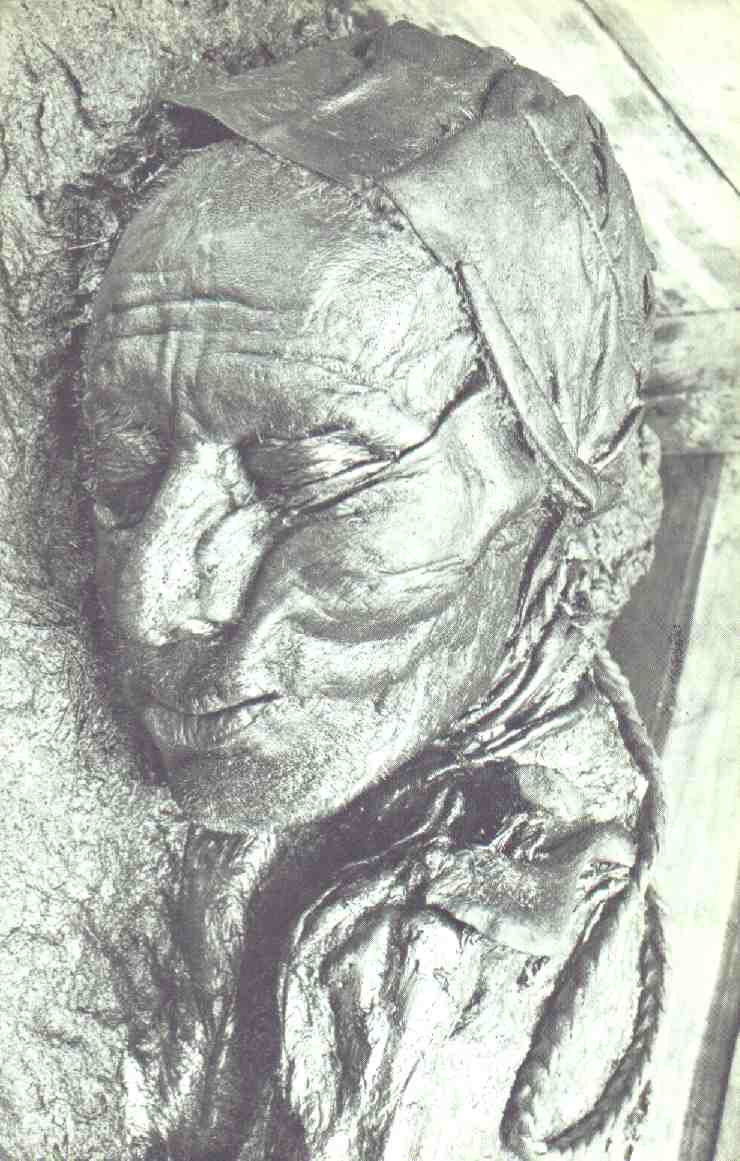
In fact, Heaney’s account in the Ploughshares interview of how he was captivated specifically by the first photo in the book, a close-up of the head of the Tollund Man, resonates fully with Barthes’ defining of punctum as an element of a photograph that “rises from the scene, shoots out of it like an arrow, and pierces me.” (In contrast, a photograph’s studium involves simply the basic subject matter, not the impact of the image on an individual viewer.) Remarking how the head of the Tollund Man “has had an enormous effect on anybody who ever looked at it,” Heaney admits outright the poignant connection he felt with the shriveled but remarkably well-preserved two thousand-year-old figure excavated from the Danish bog: “The Tollund Man seemed to me like an ancestor almost, one of my old uncles, one of those mustached archaic faces you used to see all over the Irish countryside. I just felt very close to this.”

That is not to say that Heaney’s discovery of The Bog People was pure accident: no doubt he was drawn to Glob’s book by his deep-rooted fascination with his native Irish bog—his “genuine obsession,” as he put it to interviewer Randall—whose sensuous mystery he had expressed in “Bogland,” the concluding poem of his volume Door Into the Dark, in 1969: “The wet centre is bottomless.” But his turning the page to the photograph of the Tollund Man seems truly to have involved what Roland Barthes calls “that accident which pricks me (but also bruises me, is poignant to me).” Recalling his initial response to the images in The Bog People, Heaney tells interviewer James Randall: “This wasn’t thought out. It began with a genuinely magnetic, almost entranced, relationship with those heads.” Indeed, a first line of defense against charges that Heaney’s “bog poems” were part of some cynically conceived program proffering the “pap” of “aesthetic resolution” to his “dispossessed” readers might be the fact that his punctum-prompted poem “The Tollund Man” was included utterly inconspicuously in the middle of his volume Wintering Out (1972).

In an interview with Seamus Deane in 1977, Heaney described how the poems in North “arose out of a necessity to shape and give palpable linguistic form” to the “urgency” he felt regarding Northern Ireland’s political complexity in the mid-1970s. Inspired (or “wounded,” as Barthes would say) by the literal lens that preserved on film the bodies preserved in the Scandinavian bogs, Heaney offered in his poems not a “resolution”—aesthetic or otherwise—to that complexity but rather an alternative lens (as it were) through which his readers might view its “religious intensity”: this was the lens of poetic “ulteriority”—of “saying one thing in terms of another.”

Wednesday, April 1, 2009

SEAMUS HEANEY'S "FUNERAL RITES" AND JAMIE O'NEILL'S "FORGIVENESS"

This piece first appeared in The Boston Irish Reporter, Volume 20, Number 4 (April 2009), pp. 16, 19.

Published in his landmark volume North (1975), Seamus Heaney’s poem “Funeral Rites” endures as a richly evocative contemplation of the sectarian violence that came to define life in his native Northern Ireland for the better part of three decades beginning in 1969. Included in part I of the volume, the poem is one of a series of poems mostly inspired by Heaney’s discovery of P. V. Glob’s book The Bog People (coincidentally published in English translation in 1969), a fascinating anthropological study of bodies buried in the bogs of northern Europe during the Iron Age and only recently unearthed, remarkably preserved, after several millennia.

Reflecting in his essay “Feeling Into Words” (1974) on Glob’s conclusion that many of these bodies “were ritual sacrifices to the Mother Goddess, the goddess of the ground who needed new bridegrooms each winter to bed with her in her sacred place, in the bog, to ensure the renewal and fertility of the territory in the spring,” Heaney recognized that “the religious intensity of the violence” in Northern Ireland needs to be understood not just in terms of the traditional social, economic, and political Catholic-Protestant sectarian divide in that province. Rather, it must be considered in terms of a truly archetypal “struggle between the cults and devotees of a god and a goddess”—the emblematically male crown of England, and Ireland conventionally feminized as “Mother Ireland, Kathleen Ni Houlihan, the poor old woman, the Shan Van Vocht, whatever . . .”

Heaney’s first foray into the rich territory opened up by Glob’s book was “The Tollund Man” (published in his volume Wintering Out in 1972), which begins with the poet promising himself that he will go on pilgrimage to see in person the most famous of the bog bodies:

Some day I will go to Aarhus
To see his peat-brown head,
The mild pods of his eye-lids,
His pointed skin cap.

The Danish city of Aarhus sounding as a homonym for “our house,” Heaney concludes the poem on a note of cold comfort indeed:

Out there in Jutland
In the old man-killing parishes
I will feel lost,
Unhappy and at home.

“Funeral Rites” thus represents a further example of what Heaney described as his poet’s “search for images and symbols adequate to our predicament”—a search that he framed by way of touchstones lifted from William Shakespeare (Sonnet 65) and W. B. Yeats (“Meditations in Time of Civil War”): “The question, as ever, is ‘How with this rage shall beauty hold a plea?’ And my answer is, ‘by offering befitting emblems of adversity.’”

Comprising three sections, each one in turn comprising eight, seven, and five slim unrhymed quatrains, the poem actually sits on the page as a visual emblem of Heaney’s overall poetic enterprise, which he described metaphorically in “Digging,” the opening poem of his first volume, Death of a Naturalist (1966):

Between my finger and my thumb
The squat pen rests.
I’ll dig with it.

Coaxing the reader’s eye to scroll deeper and deeper down the page (“down and down / For the good turf”), “Funeral Rites” also takes the reader into darker and darker thematic ground belied by the relative innocence of the opening section, which begins innocuously enough: “I shouldered a kind of manhood / stepping in to lift the coffins / of dead relations.” For even while describing the common rite of passage into Irish male adulthood which involves attending wakes and serving as pall bearer at funerals, Heaney employs diction (“soapstone,” “igloo,” “glacier”) that resonates with a far-northern “word-hoard” (as he puts it in the title poem of North) that evokes not only Glob’s Scandinavian world but also the history and the legacy of the brutal Viking invasions of Ireland which began in the late 8th century and continued until the Battle of Clontarf in 1014:

Dear soapstone masks,
kissing their igloo brows
had to suffice

before the nails were sunk
and the black glacier
of each funeral
pushed away.

The auspiciousness of his word-choices notwithstanding, the second section of the poem actually goes back even further historically than the Viking invasions in search of “befitting emblems of adversity” as the local funerals become more numerous and their causes more nefarious with the explosion of sectarian violence in the North in the 1970s:

Now as news comes in
of each neighbourly murder
we pine for ceremony,
customary rhythms:

the temperate footsteps
of a cortège, winding past
each blinded home.

As telling as John Milton’s oxymoron “darkness visible” (describing Hell in Paradise Lost), that self-contradicting phrase “neighbourly murder” leads by way of the words “ceremony” and “customary” to an allusion to Yeats’s great poem “A Prayer for My Daughter” (1919), in which the poet asks: “How but in custom and in ceremony / Are innocence and beauty born?” The custom and the ceremony that Heaney imagines in his time and place involves the “black glacier” of the funeral, now transformed into “a serpent,” being steered south of the border through “the Gap of the North” (the Moyry Pass, the route running out of south Armagh toward Dundalk) and on to “the great chambers of Boyne”—the series of 5000-year-old passage graves (most famously Newgrange, Knowth, and Dowth) that dot the Boyne Valley in counties Louth and Meath. Invoking for the alert reader both the Battle of Moyry Pass (1600) and the Battle of the Boyne (1690), the very course of the imagined funeral procession is marked by milestones of Ireland’s violent history that must be laid to rest.

In the third section of “Funeral Rites,” the insidious serpent of violence sealed inside the passage grave by a massive stone, Heaney imagines the procession returning to Northern Ireland “past Carling and Strang fjords” (placenames reflecting the Viking legacy in Ireland), “the cud of memory / allayed for once, arbitration / of the feud placated.” Then, imagining the spirits dwelling with equanimity in that Irish burial mound, Heaney finally—directly licensed by the Nordic resonance of Glob’s book—inserts into his poem the spirit of Gunnar, a hero from the Icelandic Volsunga Saga, “who lay beautiful / inside his burial mound, / though dead by violence // and unavenged”: though slain by the mother of his enemy Atli, in Heaney’s interpretation Gunnar yet rests in peace because the cycle of violence ends with his death. Obviously, Heaney’s art of digging in this poem leads to parable-like implications regarding reconciliation and forgiveness between the “cults and devotees” in Northern Ireland.

And that is why I thought of that poem in all its richness and density when I recently viewed a very short film (8 minutes, 58 seconds) titled Forgiveness, scripted by Jamie O’Neill, best-known as the author of that remarkable novel of the Great War and the Easter Rising, At Swim, Two Boys (2001). The film links three historical figures: British-born diehard Irish nationalist Erskine Childers, executed by an Irish Free State firing squad in 1922; his son Erskine, who served briefly (1973-74) as President of the Republic of Ireland; and Kevin O’Higgins, Minister of Justice in the Free State and one of the men who had signed the execution order for the elder Childers. Not wanting to play “spoiler,” I will mention only that the film is premised on the anecdote that Childers requested of his 16-year-old son that he seek out and shake the hand of every man who had signed his death warrant. While the film speaks to a different time and place than Heaney’s poem, it nonetheless shares the poem’s concluding vision of hopefulness. Understated rhetorically and directed and acted with elegant simplicity, Forgiveness can be viewed for free on Jamie O’Neill’s website.

Sunday, October 19, 2008

READING SEAMUS HEANEY'S "IN IOWA" IN IOWA

This piece first appeared in The Boston Irish Reporter, Volume 17, Number 10 (October 2006), p. 20.

Could I ever have imagined, when I first read Seamus Heaney’s “In Iowa” when it was published in The New Yorker in April of 2005, that someday that poem would speak directly to me—as if as a message sent from on high? Not likely. I have been reading Heaney for almost thirty years now, and one of the most striking aspects of his poetry involves its rootedness in what Heaney, in his volume Electric Light, refers to as the “known world”: primarily his boyhood world of rural south County Derry, with a few other Irish locales occasionally added to that richly layered landscape. For regular readers of Heaney, those places have become household names: Toome, Moyola, Broagh, Mossbawn, Derrygarve, Anahorish, even the intimately local Toner’s bog; and Gallarus, Clonmacnoise, Glanmore, Devenish.

Granted, Heaney does sometimes step outside of the Irish realm. France, Spain, California, and Denmark all figure in the poems of the well-traveled Nobel Laureate. So does Greece, as in “Sonnets from Hellas” he recounts his travels in the days immediately preceding the announcement of his receiving the Nobel Prize for Literature in 1995. Describing the sensation of awakening to “Wave-clip and flirt, tide-slap and flop and flow” in the seaside town of Pylos, he writes: “I woke to the world there like Telemachos, / Young again in the whitewashed light of morning.” And his poem “Known World” itself recollects his visit to Macedonia for the Struga Poetry Festival in 1978—though, never far from his own Ireland and Northern Ireland divided and subdivided by territorial politics and sectarian discord, he finds the political turmoil of the Balkan states all-too-familiar: “That old sense of a tragedy going on / Uncomprehended, at the very edge / Of the usual, it never left me once . . .”

But Iowa?

My own familiarity with that part of the Midwest is primarily through Meredith Willson’s Broadway hit The Music Man which I took my daughters to see a local production of about ten years ago. As sung by the chorus of River City townsfolk, “You really ought to give Iowa a try” functions as a sort of mantra for the middle-American dream that the musical celebrates. And of course I love W. P. Kinsella’s whimsical wonder-filled novel Shoeless Joe, the basis for the popular film Field of Dreams. “This must be heaven,” Shoeless Joe Jackson surmises, emerging from the limbo (or the purgatory) of a seemingly boundless cornfield into the perfect geometry of a beautifully manicured baseball diamond. “No,” Ray Kinsella replies. “It’s Iowa.”

But Heaney?

Included in his latest volume of poems, District and Circle, “In Iowa” is a sonnet, a crafty fourteen-liner that recounts an experience he had during a long-ago visit to the Hawkeye State. As the opening lines reveal, he felt from the start lost, not very happy, and anything but at home: “In Iowa once, among the Mennonites / In a slathering blizzard, conveyed all afternoon / Through sleet-glit pelting hard against the windscreen / And a wiper’s strong absolving slumps and flits. . . .” Infused with what Heaney has referred to famously as “the music of what happens”—the slant-rhyming and consonant-heavy “noise” of the language here reflecting how even the weather conditions are disorientingly foreign—these lines yet give way to an object in the landscape that proves surprisingly familiar to the son of a County Derry farmer: “I saw, abandoned in the open gap / Of a field where wilted corn stalks flagged the snow, / A mowing machine.”

No doubt simply left sitting there after the hay been cut and baled the previous autumn, this common piece of equipment becomes a focal point for the stranger in a strange land: “Snow brimmed its iron seat, / Heaped each spoked wheel with a thick white brow, / And took the shine off oil in the black-toothed gears.” More than just a study in black and white, however, by its very familiarity the mowing machine actually activates in the poet what he himself has described as the Irish capacity “to live in two places at the one time and in two times at the one place.” Transporting Heaney in his mind back to his “known world,” it clearly works as a stabilizing agent for the disconcerted traveler, helping to restore, at least temporarily, the equilibrium—the spirit level, as it were (to borrow from the title of his volume of poems published in 1996)—disturbed by his harrowing trip along icy I-80. Waxing biblical, he recalls the sensation of relief that he felt: “Verily I came forth from that wilderness / As one unbaptized who had known darkness / At the third hour and the veil in tatters.” The poem then ends with a sort of bemused musing on how such a seemingly innocuous moment could be so resonant with implication: “In Iowa once. In the slush and rush and hiss / Not of parted but of rising waters.”

Obviously, Heaney survived his discombobulating visit to Iowa—and lived to write about it. Well, I too survived my first visit to the land of “Silos and Smokestacks” (as a roadside sign just inside the state border announces)—thanks in part to the affirmation of Heaney’s poem. By utter coincidence, sixteen months after reading “In Iowa” in The New Yorker, I read the poem for a second time, in the pages of District and Circle, in the lobby of a sketchy Day’s Inn just off I-80 . . . the night before the life-altering experience of leaving behind my beloved first-born daughter in that “unknown world” for her freshman year at Grinnell College—in Grinnell, Iowa.

I had been forewarned by friends and neighbors who had passed through Iowa: “Nothing but cornfields from horizon to horizon.” Still, the reality exceeded even my vivid imagining of what that could be like. In fact, to borrow from Rodgers and Hammerstein’s Oklahoma!—a musical set even farther west than The Music Man—it was “corn as high as an elephant’s eye.” In August we were of course spared the wintry mess that Heaney encountered; oddly, we were also spared the debilitating heat that part of the country usually endures at that time of year. Instead, the area was fogbound at night and covered with a heavy dew in the morning—such atmospheric conditions only adding to the sense of Heaney-esque displacement that I experienced in my own way. I felt not just that I was nowhere but that I was abandoning my daughter in the middle of nowhere! Having tossed District and Circle into my suitcase almost as an afterthought, I thus took my happenstance reading of “In Iowa” in Iowa as some sort of sign that maybe, just maybe, my darling Mairéad could find herself happy and at home . . . so far from home. So far from her “known world” of Newbury Street and Harvard Square and Duxbury Beach and the Ice Creamsmith in Dorchester-Lower Mills. So far from the true “field of dreams,” of dreams come true, Fenway Park.

Time will tell (and so far so good). But in the meantime, on the very morning that we were saying our goodbyes, I learned by way of an engaging article written by English Professor Michael Cavanagh for the Summer 2006 issue of The Grinnell Magazine that Heaney’s visit to Iowa recorded in his poem was, specifically, a visit to Grinnell College in March of 1979. A warm and witty reminiscence, Cavanagh’s essay also serves as a helpful illumination of two elements of the “back story” to the poem. One involves Heaney’s general nervousness about flying—understandably exacerbated by the weather conditions as Cavanagh drove him to the airport in Cedar Rapids: small wonder that the ice storm made an impression on him deep enough to provoke a poem more than a quarter-century later. The second involves Heaney’s reference to Mennonites in the first line of “In Iowa.” In Cavanagh’s version of events, this detail figures in the poem only incidentally—the result of a pit stop at the Amana Colonies, a local Mennonite community where Heaney bought as a souvenir for his wife “a pinkish and pale green glandular-looking ashtray that said ‘Welcome to the Amanas!’” (Discovering that the ashtray was made not in Iowa but in Korea, Heaney doubled back and picked up a jar a corn-relish as well.)

For Heaney, though, it is all of a piece. Asked by Cavanagh in 1999 what he remembered of his visit to Iowa twenty years earlier, Heaney wrote in reply: “I remember the snow journey and seeing a melancholy mowing machine or hay-tosser in a blizzard-pelted field: a kind of R. Frost ‘Desert Places’ epiphany.” He then added: “I had the Amana Colonies ashtray for years.”

All I brought back from Iowa was a t-shirt with “Grinnell College” printed across the front. That and all of the usual anxiety of a father leaving his daughter not just beyond the Pale and not just beyond the bog but truly what seemed like beyond the beyond! “In Iowa once,” indeed.

Saturday, October 4, 2008

GRAPPLING WITH PROTEUS

This review of Eamon Grennan, Still Life with Waterfall (Gallery Books, 2001; Graywolf Press, 2002) first appeared in The Irish Literary Supplement, Volume 22, Number 1 (Spring 2003), p. 14.

Ironically, given the density of its prose, the “Proteus” episode of Ulysses may provide crucial backshadowing for the vision informing Eamon Grennan’s truly luminous—at times even numinous—book of poems Still Life with Waterfall. “Ineluctable modality of the visible,” Stephen Dedalus muses to himself: “Signatures of all things I am here to read, seaspawn and seawrack, the nearing tide, that rusty boot.” In many respects “Proteus” reads as James Joyce’s own musing, by way of G. E. Lessing’s Laocoon, on the relationship between the world apprehended Nebeneinander—that is, spatially, objects side by side—and the verbal artist’s necessary expression of that world Nacheinander—that is, temporally, through words presented one after another: “the ineluctable modality of the audible.” Of course, Joyce himself contests Lessing’s categorical distinctions in the ensuing episodes of Ulysses, constantly complicating the reader’s expectation of the linear nature of narrative.

More broadly, however, “Proteus” involves what may be the intrinsic enterprise of lyric poetry: the attempt to acknowledge—through the attempt to capture in words—the truly protean character of human sensation, emotion, intellection. Robert Fitzgerald’s rendering of Eidothea’s advice concerning the sea deity Proteus that Menelaus shares with Telemachus in Book IV of The Odyssey describes this enterprise: “If you could take him by surprise and hold him, / he’d give you course and distance for your sailing / homeward across the cold fish-breeding sea.” Tellingly, the opening poem of Still Life with Waterfall opens with a powerful image out of nature that embodies symbolically the undertaking of the lyric poet: “On slow wings the marsh hawk is patrolling / possibility.” Titled “At Work,” the poem reads readily not just as a graphic recording of brutal beauty but also as a metaphorical representation of artistic pursuit and execution—of a literary capturing and reconstituting of (in effect) “that scuttling minutiae of skin and innards, / its hot pulse hammering . . . / that moved so swift and silent / and sure of itself, only a minute ago, in the sheltering grass.”

Pursuing such “possibility” in poem after poem, Grennan even evokes at times a defining stylistic feature of the “Proteus” episode. In “Grid,” for example, recording how “A deer in the field of morning, tan coat gleaming— / . . . stares till he sees what you are, then a huge / expulsive whufff and he’s dolphining green waves / to a safer distance,” he could almost be invoking Joyce’s glossing for his friend Frank Budgen of his coining the word “almosting”: “That’s all in the Protean character of the thing. Everything changes: land, water, dog, time of day. Parts of speech change, too. Adverb becomes verb.” Observing in “Cold Morning” how “the eight o’clock light change[s] / from charcoal to a faint gassy blue, inventing things,” Grennan—like Joyce before him—seeks both the language and the complementary form by which to register the endless changeability of outer and inner worlds: of phenomenal experience and of the individual’s reception and processing of that experience.

In fact, Grennan finds—or invents—the very form for containing the ever-shifting potency of language: an unrhymed and rhythmically supple nonce stanza of thirteen lines that itself proves “protean” in his hands. Indeed, the effect of Grennan’s twenty-two thirteen-liners (interspersed among the fifty-two poems in the volume) resides quite literally between that created by Paul Muldoon’s countless deconstructive renovations of the classic fourteen-line form of the sonnet and Seamus Heaney’s forty-eight innovative twelve-liners which constitute “Squarings” in Seeing Things. Sometimes (like Muldoon) breaking down the formal structure into discrete strophes to reinforce the rhetorical structure of the poem, Grennan yet consistently achieves (like Heaney) that ideogrammatic compression idealized by Ezra Pound: the presentation of “an intellectual and emotional complex in an instant of time.” A single sinuous sentence, the final poem of Still Life with Waterfall both articulates and illustrates the efficacy of Grennan’s newfound form; observing a robin’s bullying of a finch cut short by the lethal attack of a sparrowhawk, Grennan concludes: “and I began to understand / how a poem can happen to you: you have your eye on a small / elusive detail, pursuing its music, when a terrible truth / strikes and your heart cries out, being carried off.”

For readers familiar with Grennan’s poetry through his four previous volumes published in North America (five in Ireland), the relative uniformity of his thirteen-liners may seem at first a radical departure for a poet whose trademark pieces (“Wing Road,” “Men Roofing,” “Two Gathering,” “Wet Morning, Clareville Road”) incline toward an organic expansiveness. But these poems, like the others that make up Still Life with Waterfall, actually share with his earlier work his characteristic attentiveness to the details of the natural world, to the subtleties of domestic relations and familial bonds, to the mirror images of art and life—in short, to what Yeats referred to as the “mere complexities” of being human. As the book’s title promises, Grennan finds a way to hold in words, to embed and to embody in stable poetic forms, the protean flux and flow of the world, the signatures of all things he is here to read.

THE POETIC BLACKBIRDS OF BELFAST LOUGH

This review of The Blackbird's Nest: An Anthology of Poetry from Queen's University Belfast (Blackstaff Press, 2006) first appeared in The Boston Irish Reporter, Volume 18, Number 1 (January 2007), p. 18.

Given that Queen’s University in Belfast now houses the Seamus Heaney Centre for Poetry, readers of Irish poetry might be forgiven if their list of writers associated with that institution begins with its most famous alumnus. But with the publication of The Blackbird’s Nest: An Anthology of Poetry from Queen’s University Belfast, Blackstaff Press, in conjunction with the Heaney Centre, has made a move toward ensuring that the list does not end with Heaney or even with the small cohort of poets who emerged alongside him in the early 1960s or in his immediate wake. Arranged chronologically by author’s date of birth, the seventy-one poems collected by editor Frank Ormsby represent poetic activity from almost the start of the twentieth century right up to the present.

The roster of fifty-three poets is impressive: many turn out to be household names, but some are surprises. Even among the former, however, some of the poems that Ormsby selects are surprises—refreshingly so. From Heaney’s body of work, for example, the editor chooses not any of the Nobel Laureate’s signature pieces (“Digging,” “The Tollund Man,” “Punishment,” “The Harvest Bow”) but “Postscript,” which urges the reader to be pervious to “big soft buffetings” that “catch the heart off guard and blow it open,” and also “A Sofa in the Forties,” which mines a memory from Heaney’s simple childhood in rural Ulster: “All of us on the sofa in a line, kneeling / Behind each other, eldest down to youngest, / Elbows going like pistons, for this was a train // And between the jamb-wall and the bedroom door / Our speed and distance were inestimable.” While Ormsby does include Ciaran Carson’s well-known “Belfast Confetti”—“Suddenly as the riot squad moved in, it was raining exclamation marks, / Nuts, bolts, nails, car keys”—he picks “Hamlet” as well, a long-lined and intentionally rambling narrative poem that shows off Carson’s ventriloquial talent as a storyteller.

A pair of poets whose work tends to be both allusive and elusive, Medbh McGuckian and Paul Muldoon have two engaging poems each in the anthology. So does Michael Longley, whose sonnet “Ceasefire” universalizes the grief of Northern Ireland’s sectarian strife by dramatizing an encounter at the end of the Trojan War: “When they had eaten together, it pleased them both / To stare at each other’s beauty as lovers might, / Achilles built like a god, Priam good-looking still / And full of conversation, who earlier had sighed: // ‘I get down on my knees and do what must be done / And kiss Achilles’ hand, the killer of my son.’”

In fact, one of the gratifying aspects of The Blackbird’s Nest is its representation of what Heaney (borrowing from Patrick Kavanagh) refers to in the book’s Foreword as the way that, in an academic environment, “Imagination . . . is in constant negotiation between the parish and the universe.” This is evident from the start, as the first two poems are translations from Latin by Helen Waddell, who attended Queen’s from 1908 to 1912; she was also awarded an honorary degree in 1934. Two translations from the work of twentieth-century Italian poet Eugenio Montale by Indian-born professor G. Singh have a similar sort of reach and richness. So does a pair of translations from Catalan poet Gabriel Ferrater by Arthur Terry, a former professor of Spanish at Queen’s; surely, the closing lines of “A Small War” speak as much to the troubled streets of Belfast as to anywhere else in the world: “I was young, like most who go to wars, / who are scared of the flesh, and destroy and abuse it. / All, in a word, emblematic, eternal.” A poem by History professor Sabine Wichert, apparently tapping into her growing up in post-WWII Germany, likewise looks beyond the literal walls of the University and also beyond the border of Northern Ireland.

Poems by writers who simply spent some time at Queen’s, in one capacity or another, add a further dimension to The Blackbird’s Nest. Crusty British poet Philip Larkin, who served as sub-librarian for five years in the 1950s, is represented by two poems, including the compelling “Church Going,” in which the apostate poet admits wryly, “Hatless, I take off / My cycle-clips in awkward reverence.” Writer in residence at Queen’s from 1991 to 1994, London-born Carol Rumens has a wonderful variation, couched playfully in the language of an unconsummated sexual encounter, on the Irish aisling (dream vision) tradition. Boston-born Janet Fitzpatrick Simmons, who taught for a time in the Department of English, has a poignant lament for her late husband James Simmons (who is also included in the anthology): “How could I have imagined this loss: / me standing over my beloved’s grave in the wind / that blows off the Atlantic visible from this Killult churchyard . . .?”

Hovering over (or perhaps behind) the entire anthology is the figure of British poet and professor Philip Hobsbaum, lecturer in English at Queen’s from 1962 to 1966 and founder of the legendary “Belfast Group” of writers, which included not only poets but also future playwright Stewart Parker and fiction writer Bernard MacLaverty. While making clear in his Introduction that Hobsbaum’s influence as poet was minimal, editor Frank Ormsby stresses the legacy of his organizing and hosting weekly meetings at his flat: “Literary friendships and productive rivalries developed and a number of poets progressed towards the pamphlet- and book-length collections that would make the north of Ireland one of the power points of Irish poetry and of poetry in English in the second half of the twentieth century.” Certainly Hobsbaum engineered the bridge between the few poetic pillars of the first half of the century represented in the anthology—John Hewitt and W. R. Rodgers, Robert Greacen and Roy McFadden—and those who would follow Heaney and company.

But as Ciaran Carson, Director of the Seamus Heaney Centre, suggests in his Afterword to The Blackbird’s Nest, poetry at Queen’s has never been fully institutionalized—a fact corroborated by the diversity of voices that round out the anthology. These include James Fenton, a part-time student in the 1960s, who writes in the Ulster-Scots dialect: “A fissle unther the deed, saft-hingin thatch, / A strippit shedda, a wheekin scad, / Ye jook crootched an shairp an quait / Amang the queelrods.” They also include the working-class vernacular of former University security guard John Campbell: “I’m an old jobbin’ poet, born outa my time, / if you buy me a likker, I’ll read you a rhyme. / I’m not hard to pay, a wee lager and lime . . . / If yer flyin’, I’ll take a quick half-in.” And Irish-language poets are represented by Gréagóir Ó Dúill and Cathal Ó Searchaigh, as well as by Gearóid Mac Lochlainn, whose “An Máine Gaelach” proves linguistically bold even in translation as “The Irish-speaking Mynah”:

00000Quixotic bird, tattered old sea-dog,
00000he stammered out amazing repartee
00000and drunken troopers’ curses,
00000all the passwords of the old Falls Road IRA.
00000Resting actor, stuck to the barstool
00000of his perch, a veritable Sweeney
00000tethered by his string of gabble.

The cover of The Blackbird’s Nest features an image of a single bird’s egg. Its title referencing the ninth-century Irish poem “The Blackbird of Belfast Lough,” which has afforded the Seamus Heaney Centre for Poetry an apt visual emblem (reproduced as a frontispiece in the book), the anthology offers only a glimpse into the poetic incubator of Queen’s University. But it is an enticing glimpse, and the nicely detailed Biographical Notes that close the book point readers toward available collections by the individual poets represented in this fine gathering.

Wednesday, October 1, 2008

A FURTHER STROLL DOWN HEANEY'S "CANOPIED PAD"

This piece first appeared in The Boston Irish Reporter, Volume 17, Number 8 (August 2006), p. 21.

Writing in this space a couple of months ago about Seamus Heaney’s poem “Broagh,” I was tempted to pause and muse at some length on a single word in the first stanza of that poem. The word was “pad,” and as I mentioned in my general commentary on the poem, it represents Heaney’s attempt to record the local pronunciation of the word “path.” Thus, his phrase “a canopied pad” refers to a path leading, through overarching trees, down to the riverbank (in Irish bruach abhana) which gives the place, Broagh, its name and the poem its title.

But there is a bit more to Heaney’s choice of that spelling than literally meets the eye, and this time I am not going resist the temptation to reflect a bit more deeply on it. Heaney himself actually provides a clue—or a cue—for how readers might recognize that, in spelling “path” the way that he does, he is grappling with the difficulty of using standard orthography (the 26 letters of the English alphabet) to record nonstandard pronunciation: in this case the not-quite-th sound that many Irish people produce where a speaker of the so-called Queen’s English would naturally hit the mark. That clue/cue appears in “Fodder,” the first poem of the volume Wintering Out, which begins: “Or, as we said, / fother . . .” The explanation for why, in certain communities of Ireland, the d sound in “fodder” would be pronounced almost like a th and why the th sound in “path” would be pronounced almost like d (or perhaps almost like t) is somewhat technical, involving using the term “phoneme” where we might want to use the simpler word “sound.” But it is relatively easy to understand when you stop and think about it—and even moreso when you try out the variant pronunciations yourself.

So here goes. The phonemes /t/ and /d/—as in the words matter and madder—are referred to by linguists (scholars devoted to the scientific study of language) as “alveolar stops.” They are produced when you stop the air flow from your lungs by holding your tongue against the alveolar ridge with the velum closed. (The alveolar ridge is the hard ridge at the front of your mouth, above your teeth; the velum is the soft curtain of flesh at the back of your mouth.) A sudden removal of the tongue will produce a /t/, a voiceless alveolar stop. If the vocal chords vibrate during the process, you will produce a /d/, a voiced alveolar stop. Try pronouncing matter and madder while holding your fingers lightly against your throat: you will feel the vibration on madder but not on matter.

In contrast, the two “th” phonemes, /y/ and /ð/—as in the words ether and either—are referred to by linguists as “interdental fricatives.” They are produced by the tongue obstructing the air stream between the upper and the lower teeth, or at the bottom of the upper teeth. The /y/ is a voiceless interdental fricative, the /ð/ is a voiced interdental fricative. Try pronouncing ether and either, making sure (even in an exaggerated way) that your tongue is decidedly between your teeth: again, you should be able to distinguish between the voiced and the voiceless phonemes.

Now here is the catch in Ireland. The Irish language—the language spoken by the majority of Irish people until the middle of the 19th century—does not include the phonemes /y/ and /ð/. So, just as “Hiberno-English,” the English language as spoken in Ireland today, still owes obvious debts to the Irish language through adoption or adaptation of both vocabulary (loanwords) and syntax (certain grammatical structures), it also owes a debt of pronunciation to the Irish language in that many Irish people produce an “allophone,” conditioned by their ancestral language’s system of phonemes, which simply approximates the target phoneme when attempting to produce either /y/ and /ð/ or /t/ or /d/. (Though more common involving the attempt to produce /y/ and /ð/, the “error” can occur going either way). What happens is that they place their tongue on the back of the upper teeth—below the alveolar ridge which would produce an alveolar stop, yet not between the teeth which would produce an interdental fricative. The result, not found in “standard English” pronunciation, is what linguists call a “dental stop.” Thus the word “fodder” gets pronounced fother (more or less) and “pad” appears for the word “path” in Heaney’s poem “Broagh.”

Or so Heaney intends. Strictly speaking, the voiced alveolar stop /d/ at the end of “pad” does not accurately register the voiceless dental stop, the not-quite-/y/ that Heaney is really aiming for at the end of “path”: probably the voiceless alveolar stop /t/ would be a closer approximation of the “not-quite-th” sound that many Irish people would produce. But that inexactness reflects some of the imprecision inherent in attempting to represent nonstandard pronunciations with standard orthography—to say nothing of how the appearance of “pat” on the page might have caused undue confusion for readers not tuned in to Heaney’s intention here.

As it turns out, Heaney’s intention—or his reach in attempting to register that dental stop—dovetails with a “language question” that was made conspicuously manifest in several ways in the decade or so following the publication of “Broagh” and “Fodder” in Wintering Out in 1972. Perhaps achieving its highest profile in Brian Friel’s marvelous play Translations, first staged by the Field Day Theatre Company in Derry in 1980, this “question” has many prismatic facets involving Ireland’s linguistic heritage. Friel explores in particular the legacy of the politics of naming associated with the Ordnance Survey mapping of Ireland in the 1830s. The play’s most dramatic moment occurs when the British sapper Yolland tries to persuade his Irish translator Owen that they should retain the local Irish placename “Tobair Vree” instead of substituting some relatively random Anglicized name. “Something is being eroded,” Yolland declares, and Owen begrudgingly concedes the point.

More to the point of Heaney’s spelling of “path,” though, is Tom Paulin’s pamphlet, published by Field Day in 1983, titled “A New Look at the Language Question.” Observing that the English language as spoken in Ireland “lives freely and spontaneously as speech, but . . . lacks any institutional existence and so is impoverished as a literary medium,” Paulin argues that “A language that lives lithely on the tongue ought to be capable of becoming the flexible written instrument of a complete cultural idea.” While Paulin focuses more on “discursive prose” and more on vocabulary—“a word like ‘geg’ or ‘gulder’ or Kavanagh’s lovely ‘gobshite’”—the principles are essentially the same regarding poetry and regarding pronunciation. No less than his inclusion of words like “rigs,” “docken,” “ford,” and “boortrees” in “Broagh,” Heaney’s representation of the local pronunciation of “path” brings his readers that much closer to that place along the riverbank, that place with its “black O” in the first syllable and its “last / gh the strangers found / difficult to manage.”