Friday, February 1, 2013

JOYCE’S DUBLIN: GONE WITH THE WIND?


This piece first appeared in The Boston Irish Reporter, Volume 24, Number 2 (February 2013), 19.

Punctuated with headlines to mark its being set in conjoined newspaper offices, the seventh episode of James Joyce’s Ulysses, “Aeolus,” itself punctuates the novel, announcing by way of its sudden typographical shift—and indeed by its first headline—that both the characters and the reader are now located IN THE HEART OF THE HIBERNIAN METROPOLIS. 

Specifically, most of the activity in the episode takes place in the vicinity of Sackville Street (renamed O’Connell Street in 1924), the main thoroughfare of Dublin both in 1904, when Ulysses is set, and now.  Anticipating the buffeting flurry of busyness that Joyce’s characters Leopold Bloom and Stephen Dedalus will experience inside the figuratively blustery newspaper offices nearby, the episode begins amidst hubbub in the literal center of that street, the hub of the Dublin United Tramway Company: “Before Nelson’s pillar trams slowed, shunted, changed trolley, started for Blackrock, Kingstown and Dalkey, Clonskea, Rathgar and Terenure, Palmerston Park and upper Rathmines, Sandymount Green, Rathmines, Ringsend and Sandymount Tower, Harold’s Cross.”

Famously, while writing Ulysses, Joyce declared to a friend, “I want to give a picture of Dublin so complete that if the city one day suddenly disappeared from the earth it could be reconstructed out of my book.”  Joyce’s intention continues to resonate for readers of the novel in our time, and Joyceans—both professionals (mostly academics like yours truly) and amateurs (devotees of the written word)—continue to walk literally in the literary footprints of Joyce’s memorable cast of characters.  But as I can personally attest, more and more of those footprints have disappeared—have gone as if blown away by Aeolus, the god of wind whom Joyce evokes in Ulysses—as the city has morphed inevitably and continually during the century-plus since Joyce began inscribing it on the page.  More and more that reconstruction has to be undertaken in the mind’s eye of the reader-turned-daytripper.

To that end, I have been browsing around recently in a book about Dublin’s trams, those clanging conveyors of the citizenry of the “metropolis” during Joyce’s time.  Published in 2000, Michael Corcoran’s Through Streets Broad and Narrow: A History of Dublin Trams, actually engages closely with Joyce’s Dublin, as the tramway system was approaching a high point in its evolution at the time of the single day immortalized by Joyce in Ulysses—June 16, 1904: as Corcoran explains, a major extension had been completed the previous autumn, and October of 1904 would see the introduction of the DUTC’s first top-covered trams.  While citing “four apparent errors, one of them perhaps intentional,” Corcoran nonetheless gives Joyce high marks for his depiction of the system at various points in Ulysses, and many of the basic facts in Corcoran’s narrative illuminate just how imaginatively Joyce took the geography that lay literally beneath his feet and reworked it in his fiction.

Writing specifically about the opening of the “Aeolus” episode, Corcoran notes: “The four tracks coming past the Abbey Street junction became six between there and the Pillar, the four inner ones going through a series of crossovers to form four terminal stubs right in front of the Pillar’s entrance door.  From these stubs began the journeys to all but one of the southside destinations listed by Joyce.”  How fitting that an episode defined by verbal bluster and physical bustle and shunting about inside the newspaper offices should begin in the center of Sackville Street; as Corcoran notes further: “It has been calculated that a tram could make upwards of 60 different movements between O’Connell Bridge and Rutland (Parnell) Square.”

Gradually superseded by buses, taxis and private automobiles, the tramway system in Dublin had run its course by 1949; so only the earliest of “Joyceans”—professional or amateur—would have had firsthand experience of the DUTC as Joyce knew it.  In a sense, then, the trams, which actually appear in numerous episodes of Ulysses, embody the theme of “Gone with the wind” (a phrase spoken by a character in “Aeolus”) that latter-day daytrippers have to come to terms with in trying to reconstruct Joyce’s Dublin.

I was thinking that specifically last summer as I paused before a Joycean landmark that has withstood time’s tax and toll: the statue of “Ireland’s national poet,” Thomas Moore (1779-1852), that stands on a traffic island next to Trinity College in the center of Dublin.  Renowned for his “Irish Melodies”—mostly sentimental ballads set to traditional Irish airs—Moore figures frequently in Joyce’s writing, beginning with several references and allusions in Dubliners and continuing through Finnegans Wake.  But in “Lestrygonians,” the episode of Ulysses immediately following “Aeolus,” the reference is especially complex and thus especially revealing of just how Joyce engaged in his imagination with what he once referred to as “the catalogue of Dublin’s street furniture.”

Writing with Leopold Bloom as the episode’s center of narrative consciousness, Joyce packs a lot into just the first two sentences registering Bloom’s passing glance at Moore’s statue: “He crossed under Tommy Moore’s roguish finger.  They did right to put him up over a urinal: meeting of the waters.”  Even a casual viewer of the statue today will notice that Moore is represented in a “poetical” pose, with a book in his left hand and the index finger of his right hand conspicuously raised as if to emphasize a particular point.  But most casual readers of Ulysses will not recognize that the word “roguish” alludes to an elaborate hoax perpetrated in the London periodical Fraser’s Magazine in 1835 by a literary Irish priest, Father Francis Mahony (1804-66).  Having created a fictional counterpart named Father Prout and also Oliver Yorke, the editor of The Reliques of Father Prout, a collection of his purported literary and cultural musings, Mahony had Father Prout set out to prove, in an essay titled “The Rogueries of Tom Moore,” that a number of Moore’s poetic verses are plagiarisms of verses first written in French, Latin or Greek—and as proof he presented the originals . . . which Mahony himself had written.  Evidently, in Joyce’s mind Mahony’s own “roguery” would still be familiar in 1904 to even an ordinary Dubliner like Bloom.

Likewise, Joyce allows Bloom plausible familiarity with one of Moore’s most popular ballads, “The Meeting of the Waters,” which evokes the “sweet vale of Avoca” in County Wicklow where the rivers Avon and Avoca converge.  While this reference may still resonate today for readers with an ear for Irish music, fewer and fewer Joyceans will know firsthand that, at least until the late 1970s, the traffic island which is home to Moore’s statue was also home to a men’s public lavatory.  Yet that essential bit of knowledge illuminates not only Bloom’s (and Joyce’s) irreverent humor at Moore’s expense but also the next sentence in the episode: “Ought to be places for women.”  As Bloom’s throwaway musing reflects, Dublin Corporation, in a manifestation of lingering Victorian prudery, in effect denied the fact of female bodily functions by affording no public accommodations for those functions.

All of which, remarkably, eventually loops back to the Dublin United Tramway Company at the turn of the twentieth century.  For just as Bloom’s glance at Moore’s statue transports the Joycean reader all the way back to Father Mahony’s “Rogueries” in 1835, so does Bloom’s sensitivity to women’s needs carry the reader forward to 1961 and the publication of The Hard Life by Flann O’Brien, one of the preeminent Irish novelists in the generation immediately following Joyce.  Set essentially in “Joyce’s Dublin” (the narrative action takes place between 1890 and 1910), this darkly comic novel has as a subplot a scheme by one Mr. Collopy to outfit tramcars to provide the discreet accommodations for women that Bloom sees lacking.  Mr. Collopy explains his plan to his friend, a German Jesuit named Father Kurt Fahrt: “Let us say that a lady and a gentleman are walking down the street and have a mind to go for a stroll in the Phoenix Park.  Fair enough.  But first one thing has to be attended to.  They wait at a tram stop.  Lo and behold, along comes the Black Tram.  The lady steps on board and away she goes on her own.  And the whole beauty of the plan is this: she can get an ordinary tram back to rejoin her waiting friend.”

Obviously, Mr. Collopy’s scheme is ludicrous.  But O’Brien’s linking it with Dublin’s trams underscores the centrality of the tramway system to Dublin life a century and more ago, and in the process underscores how a book like Corcoran’s Through Streets Broad and Narrow can be so helpful for the latter-day reader committed to “reconstructing” the heart of the Joycean metropolis.  Aptly enough, my browsing through that book conveyed me not only deep into DEAR DIRTY DUBLIN (another headline from “Aeolus”) but also backward and forward in Ireland’s rich literary history.

Wednesday, August 1, 2012

A CLASSIC MODERN NOVEL FROM FERDIA MAC ANNA

This piece first appeared in The Boston Irish Reporter, Volume 23, Number 8 (August 2012), 13.

Understandably, a casual reader of Ferdia Mac Anna’s recently reissued first novel, The Last of the High Kings, might think of it in Joycean terms.  Originally published in 1991, this novel of youthful development seems, on the surface, to share some essential thematic territory with the spirit of non serviam articulated famously by James Joyce’s quasi-autobiographical character Stephen Dedalus in A Portrait of the Artist as Young Man: “I will not serve that in which I no longer believe, whether it call itself my home, my fatherland, or my church.”

Yet, even aside from the fact that he is not cast in the role of “the artist”—that is, in the mold of the self-consciously sensitive individual committed, in his struggle against the values of a repressive society, to deploying the Joycean strategy of “silence, exile and cunning”—Mac Anna’s protagonist Frankie Griffin emerges as much more, or at least much other, than a late-twentieth century variation on Joyce’s Stephen.  Set in the north-of-Dublin community of Howth in the summer of 1977, Mac Anna’s novel is ultimately very much a product of its own place and time and is infused with a comic spirit that distances it both tonally and stylistically from Joyce’s signature ironic treatment of his Dublin-centered creation.

Not unusually for a first novel (and in that regard not unlike Joyce’s Portrait), The Last of the High Kings is also infused with many details drawn from the author’s own life.  As Mac Anna registers his childhood and his adolescence in The Last of the Bald Heads, his memoir published in 2004, these details include not only Howth as setting but also essential elements that propel the narrative of the novel: a domineering and eccentric mother, a frequently absent father, a male youth longing for individual identity in a community and culture (social, scholastic, political) demanding blind conformity to established codes of conduct.  As Mac Anna acknowledges in recounting the family’s move from Killiney to Howth, even the novel’s title derives from a refrain that he endured throughout his growing-up years: “On the first day, the local kids came around to check us out.  ‘Where are you from?’ one asked.  ‘We come from the High Kings of Ireland,’ I replied, repeating what Mother had told me to say.  The kids were not impressed.  A girl said that she was going to ask around about us.  She reckoned we were from Cabra.”

In fact, one of the central tensions of the novel involves Frankie’s mother’s designating him for greatness from a very young age: “At home, Ma told him he was a special boy, descended from the ancient Celtic warriors and High Kings.  She said there was powerful blood in his veins because he was the firstborn son.  Someday he’d be a great man, she promised; he’d be a professor of history, then President of Ireland.  That kind of talk made him feel great.  Every time Ma leaned over him, he felt warm and secure and lightheaded.  It was like being bathed in his own personal spotlight.”  But by the time Frankie reaches his teenage years, such puerile gratification has been replaced by his interest in girls, drink, and rock ’n’ roll: “At home Ma gave out to him about everything.  She said his hair was a disgrace.  She didn’t like his clothes or his habits or his friends.”  Clearly, Frankie has trouble living up to his mother’s expectations for a descendent of “the High Kings of Tara” whose “bloodline is one of the most revered in Europe.”

Ultimately, the tension between Frankie and his mother centers on her “politics”: a diehard nationalist and a local activist in the Fianna Fáil party, she actively despises any and all Irish Protestants, whom she labels sweepingly as “Brits.”  Indeed, the climactic confrontation of the novel involves Frankie being accosted by his mother for his burgeoning romantic (and sexual) relationship with a local Protestant beauty, Jayne Wayne, whose mother happens to be from Belfast and whose father happens to be from Essex in England.  “No Brit bitch is going to come between an Irish Celtic warrior mother and her eldest son,” she launches her verbal assault on Frankie: “Who would have thought that my own flesh and blood would have turned out to be a dirty Brit-lover.  You’re as bad as the dirty Black and Tans.  What about the 1916 Rising when Jayne’s father’s countrymen shot dead thousands of innocent Irish revolutionaries?  What about Father Murphy’s glorious Rising of 1798?  What about Wolfe Tone and poor old Robert Emmet?  Look what they did to Parnell.”  She then proceeds to assault Frankie physically, pelting him with whatever she finds close at hand, starting with a bronze bust of Cuchulainn from the mantelpiece.  Frankie retreats out the front door and down the drive: “When he looked back, he saw Ma in the light from the open doorway, darting in and out of the house, hurling objects out into the darkness after him.  A book clunked onto the tarmac.  Then a picture frame smashed on the path.  His brand new Stranglers album went gliding over his head into Figgis’s garden.  Within moments, every album he owned seemed to be flying through the air.  He recognized the sleeve of ‘The Allman Brothers Live at the Fillmore East’ just before it thudded into the telegraph pole above his head and went spiraling off into the blackness.”

Tellingly, of course, the mother’s passionate nationalism reflects the spirit of the place and the time that Mac Anna chooses for his novel’s setting.  Born in 1955, Mac Anna sees both himself and his younger protagonist as products, or victims, of the nearly six-decade domination of the Irish political and economic landscapes—and thus of the social and cultural landscapes as well—by Éamon de Valera, nationalist rebel, later Prime Minister, and later still President of Ireland.  Founded by de Valera in 1926, Frankie’s mother’s beloved Fianna Fáil party set the tone of social conservatism and lingering republican nationalism that defined the heart of the twentieth century in Ireland.  Frankie’s resistance to his mother’s political bent thus represents, even in this novel characterized by hilariously comical scenes and dialogue, a serious indictment by Mac Anna of the spiritually dreary times that he himself grew up in and that continued to characterize both Dublin and the countryside up until the economic boom of the 1990s known as “the Celtic Tiger.”

The Last of the High Kings was adapted by Gabriel Byrne and David Keating as a film, directed by Keating, with the same title in 1996.  While featuring cameo appearances by Byrne, Stephen Rea, and Colm Meaney, the film version—blandly re-titled Summer Fling when released in North America—has mostly a North American cast playing Irish roles, including Jared Leto as Frankie and Catherine O’Hara as his mother.  It falls short of being a cinematic must-see.

But reissued by New Island Books as part of their “Modern Irish Classics” series, The Last of the High Kings definitely belongs in the “classic” category.  Its update of the Irish coming-of-age novel etched so indelibly by Joyce in A Portrait rings as utterly true as Joyce’s to the period of Irish life that it responds to and reflects and refracts.  Setting the novel in his native Howth, a fishing village located on a promontory nosing into the Irish Sea nine miles north of Dublin’s city center, Mac Anna absolves himself of writing in the long literary shadow cast by “Joyce’s Dublin,” a favorite playground of casual readers and Joyce scholars alike.  He also absolves himself of having to engage with the more complex social and cultural landscape of “the heart of the Hibernian metropolis,” allowing him to focus on Frankie’s particular domestic situation as the window opening onto the larger world of modern Ireland. 

At the end of A Portrait, Joyce has his protagonist reject his literal father to embrace his mythic father, the Greek inventor Dædalus: “Old father, old artificer, stand me now and ever in good stead.”  True to the prevailing comic temper of his novel, Ferdia Mac Anna ends The Last of the High Kings with Frankie Griffin reconciled, at least for now, with his mother, and he even joins her and his siblings in greeting their prodigal father returning from one of his long absences: “‘Wave, everybody, wave,’ Ma said, her face shining.  ‘Show your father what a great family he has.’  Everyone waved.”


Tuesday, March 1, 2011

DEEP IN THE HEART OF DERRY

This piece first appeared in The Boston Irish Reporter, Volume 22, Number 3 (March 2011), 30.

“The schoolmen were schoolboys first.” So James Joyce has Stephen Dedalus muse in the “Scylla and Charybdis” episode of Ulysses. These words would have made an apt epigraph for The Boys of St. Columb’s (The Liffey Press, 2010), Maurice Fitzpatrick’s book of commentary and interviews published as a companion piece to the film of the same name that he co-wrote and co-produced: both book and film focus on one of the most momentous events in the history of modern Northern Ireland. Generally overshadowed by the outbreak of sectarian violence in the late 1960s that defined the last three decades of the twentieth century in the North, this event is the passage, in 1947, of the Education Act which made secondary education free for any student who passed the auxiliary test known as Eleven Plus. Essentially, in the film and the book, Fitzpatrick sets out to prove a thesis: that the implementation of this act gave rise in a single generation to a professional class of Catholics who would provide visionary leadership in reshaping the social and political culture of Northern Ireland in the last half of the century. His testing ground for this thesis is very specific: St. Columb’s College, a diocesan-run Catholic boys school in the heart of the city of Derry.

For some readers of the book and viewers of the film (available on DVD), the first attraction may be the new insight that Fitzpatrick’s focus offers into two of the best-known and most distinguished alumni of St. Columb’s—Nobel Prize-winning poet Seamus Heaney and scholar, critic and novelist Seamus Deane. Indeed, these two writers—and the relationship between those two “schoolmen” who were once schoolboys together—figure prominently in Fitzpatrick’s project. Yet they are still just part of a larger ensemble comprising a cross-section of graduates from diverse backgrounds and with diverse interests and talents who went on to become household names in one field or another: musicians Paul Brady and Phil Coulter; politician and Nobel Peace Prize recipient John Hume; well-traveled ambassador James Sharkey; political activist Eamonn McCann, one of the founders of the civil rights movement in Northern Ireland in the late 1960s; and Edward Daly, Bishop of Derry from 1974 to 1993 (the heart of the so-called “Troubles”) who as Fr. Daly had become known worldwide through the image of him waving a blood-stained white handkerchief while ministering to a mortally wounded victim of the Bloody Sunday massacre in 1972.

While some of these men knew each other during their years at St. Columb’s (mostly during the late 1940s and the 1950s) and while most have in later life crossed orbital paths with each other, what they really have as their first common denominator is the experience of attending St. Columb’s. That in itself proves fascinating for the viewer of the film and the reader of the book, as each of the eight men featured has a unique recollection of and a unique set of reflections on that experience. For instance, the experience of attending the school was vastly different—in some cases for better, in some cases for worse—for boarders and for day students. It was also vastly different depending on personal domestic circumstances and individual sensibility. For some of Fitzpatrick’s subjects, their time at the college was transformative in a mostly affirming way. Phil Coulter, for example, asserts: “I would have no doubt that whatever combination of talent, tenacity, temperament and work ethic I have, I would owe that to St. Columb’s.” Likewise, James Sharkey remembers his final two years as “really a preparation for something extraordinary”: “No matter how much you were a rebel and rejected education, you were always aware that there were teachers of a certain sophistication with whom you empathised. . . . I owe those people a special debt of gratitude.”

For others, however, the St. Columb’s experience was utterly traumatic. A day student from the lower-class Bogside area of Derry, Eamonn McCann remembers being treated as “an interloper” and remembers also that “The regime at St. Columb’s was quite brutal and was run by fear”: “It was run by a lot of brutality—not just slaps but the use of fists. I was knocked unconscious in an Irish class once for something very, very trivial.” Paul Brady is even more emphatic as he summons up his earliest memories of the school as experienced by a sensitive bespectacled boy from the town of Strabane, Co. Tyrone: “Shock, horror, awe, shock. I had no experience that was going to prepare me for going into a boarding school. Being in a monocultural, monosex kind of atmosphere was quite a shock to me, and it took me a long time to get accustomed to it. I didn’t have any experience of other parts of Northern Ireland, say east of the Sperrin Mountains which is a whole different vibe altogether, with strange accents, which now I know to be only south Derry accents and Antrim accents. But at the time they might have been from Timbuktu to me.” Of the eight alumni of St. Columb’s interviewed by Maurice Fitzpatrick, Brady seems to have suffered the most from the concomitant cultures of violence and of conformity imposed equally by the priests and the lay teachers at the school and either resigned to or absorbed as the norm by the vast majority of the students. His interview is particularly poignant.

Not surprisingly, not one of Fitzpatrick’s subjects is unequivocally nostalgic about his experience at St. Columb’s. But of all the interviewees, Seamus Deane is most detailed—and uncompromisingly so—in his analysis of the ministry of fear (as it were) that defined life at the college. Perceiving the institution of the Catholic Church as “a system of authority that was changing itself into a system of power, and doing that mistakenly under the aegis of the Socialist Government’s Education Act,” Deane parses with riveting rigor the complex implications of the dynamic that played out at St. Columb’s: “They couldn’t handle the effect of that legislation. The Roman Catholic Church couldn’t remain what it had been: once they had to teach the working classes, their class prejudice revealed itself. Every one of them was anxious nevertheless to exert authority, reproducing the structures of domination that the state had used; mass education exposed a church that had won respect from being oppressed. The myth of the priest could not survive his becoming a teacher in a strenuous situation. So it was sort of a melancholy place in that respect, made the more so by the excellence of some of the very good teachers.”

Yet the prevailing theme of The Boys of St. Columb’s remains that articulated by Seamus Heaney in response to Maurice Fitzpatrick’s question about the enduring “impact” of the 1947 Education Act. Appreciating how “people with merit, with intelligence, were given the scholarship, so that talent brought forward a whole new set of people,” Heaney elaborates: “That arrival into the adult population, eventually, of educated people from the working class, from farming backgrounds, brought a new kind of critical intelligence, a new kind of appetite for excellence into play. They had a sense of adventure, a sense of themselves as a generation with some sense of possibility and advantage and renewal. They were aware of the people who hadn’t got the advantages in their family and among their neighbours. They were political in that they had a strong sense of being responsible.”

And in that regard the resonance—and thus the importance—of The Boys of St. Columb’s as a documentary record extends far beyond even the engaging “tales told out of school,” about school, by an octet of men as candid as they are articulate. One way in which their personal stories resonates is as evidence of the value of education in the particular context of Northern Ireland: as Fitzpatrick asserts in his Introduction to the book, behind the stock images of the Northern predicament and the sectarian conflict—first the media shots of posturing politicians and then the literal shots and explosions heard ’round the world—there was “history to be understood.” Perhaps just as important is the broader message that the film sends out about education as the great liberator because it is first the great equalizer. The Boys of St. Columb’s is thus a sort of parable for how education—not arms or armies—can be the vehicle for change not just in one particular context but globally.

Friday, October 1, 2010

POETRY AND GRIEF: JAMES JOYCE'S "TILLY"

This piece first appeared in The Boston Irish Reporter, Volume 21, Number 10 (October 2010), 18.

For the past few weeks, for one reason or another, I have been thinking about poetry and grief—or more specifically, about poems which register and express grief over the loss of a loved one. I have been especially attuned to lyric poems—concise and precise articulations of the emotions involving loss that provide what Robert Frost once called “a momentary stay against confusion.” (Incidentally, Frost also once observed: “Poetry is about the grief. Politics is about the grievance.”) The Irish may not have the market cornered on this sort of poem, but Irish writers have certainly turned out their fair share.

One obvious example, frequently anthologized, is Seamus Heaney’s “Mid-Term Break,” an early poem in which he recalls the death of a younger brother struck and killed by a car while the future poet, still just a boy himself, is away at boarding school. The poem leads the reader through the whole experience—from the news reaching young Seamus at school, through his being driven home by neighbors, then seeing his father in tears and being embarrassed by “old men standing up to shake my hand // And tell me they were ‘sorry for my trouble.’” What stays with the reader, however, is neither the glimpse of the poet’s distraught mother coughing out “angry tearless sighs” nor even the arresting image of his little brother in the first two lines of the final tercet—“Wearing a poppy bruise on his left temple, / He lay in the four foot box as in his cot.” Rather, reinforced by full rhyme with the penultimate line of the poem (“No gaudy scars, the bumper knocked him clear”), the recognition etched in the standalone final line is also etched indelibly in the reader’s memory: “A four foot box, a foot for every year.” In his essay “Hamlet and His Problems,” poet T. S. Eliot describes the challenge faced by the artist attempting to convey a complex and subtle emotion: “The only way of expressing emotion in the form of art is by finding an ‘objective correlative’; in other words, a set of objects, a situation, a chain of events which shall be the formula of that particular emotion; such that when the external facts, which must terminate in sensory experience, are given, the emotion is immediately evoked.” Acknowledging the almost unspeakable sadness of a child’s death, the equation that Heaney draws between his brother’s life cut short and the miniature coffin he lies in reads as a classic example of Eliot’s idea.

The objective correlative may not be the only way to express publicly an emotion as private as grief, but it certainly works in “Reo” by Seán Ó Ríordáin, considered by many readers and scholars the preeminent Irish-language poet of the twentieth century. In an essay on Ó Ríordáin in his book Repossessions: Selected Essays on the Irish Literary Heritage, Professor Seán Ó Tuama observes that in this poem “Ó Ríordáin consciously or unconsciously reverses and transforms one of the oldest European love-formulas, that of the poet walking out one leafy summer morning and meeting a fair lady. Here it is a winter morning, frost in the air, the boughs bare and he encounters not love but death. . . . This is quite probably . . . [a] lament for his mother, beautiful, unique, and absolutely in the Irish as well as in the European tradition.” Translated as “Frozen” by Valentine Iremonger, in its matter-of-factness “Reo” requires no paraphrase:

On a frosty morning I went out
And a frozen handkerchief faced me on a bush.
I reached to put it in my pocket
But it slid from me for it was frozen.
No living cloth jumped from my grasp
But a thing that died last night on a bush,
And I went searching in my mind
Till I found its real equivalent:
The day I kissed a woman of my kindred
And she in the coffin, frozen, stretched.

Interestingly, in his recent translation of “Reo,” Greg Delanty substitutes for “equivalent” the word “correlative”—a telling nod toward T. S. Eliot in this poem in which the disconcerting frozenness of the handkerchief transmits to the reader the disconcerting personal loss that is the poem’s true subject.

For both Patrick Kavanagh and James Joyce, the loss of a beloved father likewise demands an expression of grief more crystallized than discursive. In “Memory of My Father,” Kavanagh invites the reader to see the personal in the same way that he does—relative to the universal:

Every old man I see
Reminds me of my father
When he had fallen in love with death
One time when sheaves were gathered.

For Kavanagh, the absence of his father (who died in 1929, ten years before this poem was written) is accentuated poignantly by various paternal avatars whom the poet encounters randomly: “That man I saw in Gardiner Street / Stumble on the kerb,” “the musician / Faltering over his fiddle / In Bayswater, London.” Paradoxically, his father becomes an enduring presence by way of the familiar figure cut by these men.

For Joyce, the objective correlative resides in a different sort of universal—in the cycle of generational death and birth illuminated for him by the birth of his grandson Stephen shortly after the death of John Joyce, the author’s father. In a letter written in Paris on January 1st, 1932 (coincidentally, to T. S. Eliot), Joyce explained how his sorrow over his father’s death two days earlier was compounded by guilt over his rigid adherence to self-imposed exile from Ireland: “He had an intense love for me and it adds anew to my grief and remorse that I did not go to Dublin to see him for so many years. I kept him constantly under the illusion that I would come and was always in correspondence with him but an instinct which I believed in held me back from going, much as I longed to.” Six weeks later, on the day his grandson was born, February 15th, Joyce captured in the concluding quatrain of his succinct four-stanza poem “Ecce Puer” (Latin for “behold the boy-child”) the essence of filial grief:

A child is sleeping:
An old man gone.
O, father forsaken,
Forgive your son!

But the poem of Joyce’s that I keep returning to with regard to the expression of grief is one that he wrote in 1904, in response to the death of his mother, Mary Jane (“May”) Murray Joyce, in August of 1903. Joyce originally titled the poem “Cabra,” after the northside Dublin community where the family was living (at 7 St. Peter’s Terrace) at the time of Mrs. Joyce’s passing, and originally intended to include it in his volume Chamber Music, published in 1907. But feeling that its sober tone did not fit with the rest of that gathering, he withdrew it and withheld it from publication until 1927, when he placed it, re-titled “Tilly,” at the opening of his 13-poem chapbook Pomes Penyeach. (The word “tilly” means “a little bit extra”—which seems to be how Joyce thought of this poem relative to the others in the volume, which were all written between 1912 and 1924 in Trieste, Zurich, and Paris.)

Comprising three free-verse quatrains, “Tilly” begins with a two-stanza depiction of a cattle drover written from the perspective that Joyce has his character Stephen Dedalus describe in A Portrait of the Artist as Young Man as the “dramatic form”—the literary point of view in which “The personality of the artist . . . refines itself out of existence, impersonalizes itself, so to speak”:

He travels after a winter sun,
Urging the cattle along a cold red road,
Calling to them, a voice they know,
He drives his beasts above Cabra.

The voice tells them home is warm.
They moo and make brute music with their hoofs.
He drives them with a flowering branch before him,
Smoke pluming their foreheads.

Crucially, though, the third stanza represents a shift in perspective to what Stephen Dedalus calls “the lyrical form”—“the form wherein the artist presents his image in immediate relation to himself”—as the introduction of the first-person point of view (the “I” in the third line) reflects Joyce’s acknowledgement of a profound personal investment in the poem’s subject matter:

Boor, bond of the herd,
Tonight stretch full by the fire!
I bleed by the black stream
For my torn bough!

In effect, the broken-off branch used by the drover as a switch to steer the cattle homeward becomes for the speaker in the poem (ostensibly Joyce himself) what Stephen Dedalus calls “the simplest verbal vesture of an instant of emotion”—the emblem of what has been irreparably broken in the life of the speaker: it becomes what the alert reader might recognize in other words as an objective correlative for irreversible loss. Read this way, this “tilly” of a poem written in 1904 stands not only as a subtle lyric poem in its own right but also an intriguing companion piece to the “Telemachus” episode of Joyce’s masterwork Ulysses, set on the morning of June 16th, 1904, which focuses in large part on Stephen Dedalus’ unresolved feelings of grief—like Joyce’s own—regarding the death of his mother almost a year earlier.

Sunday, August 1, 2010

(AP)PRAISING MICHAEL HARTNETT

This piece first appeared in The Boston Irish Reporter, Volume 21, Number 8 (August 2010), 22.

One of the many wonderful scenes in Flann O’Brien’s novel At Swim-Two-Birds has Jem Casey, “the Poet of the Pick and the Bard of Booterstown,” kneeling to assist the injured King Sweeny, a man of words in his own right: “poet on poet, a bard unthorning a fellow-bard,” O’Brien inscribes that moment. Almost inevitably I thought of that scene when I finally sat down with Notes from His Contemporaries: A Tribute to Michael Hartnett, a substantial book of poems and prose that landed on my doorstep around a year ago. A poet of remarkable range and depth who is yet generally overlooked, and thus underestimated, by readers and critics alike, Michael Hartnett died in 1999 at the young age of 58. Commemorating one of Ireland’s most intriguing poets of the last half of the twentieth century, this large-format softcover—compiled and privately published by his son Niall—is aptly titled, as it invokes a series of engaging poems, “Notes on My Contemporaries,” that Hartnett composed in the late 1960s praising and appraising a number of his fellow Irish poets, some of whom return the favor here. Poet on poet and bard on bard, indeed.

Hartnett may be best known for his early poem “A Small Farm,” which opens memorably: “All the perversions of the soul / I learnt on a small farm. . . .” He is also legendary for his decision in the mid-1970s to abandon (temporarily, as it turns out) the English language to write only in Irish; he made his intention known in a powerful poem titled “A Farewell to English”:

I have made my choice
and leave with little weeping:
I have come with meagre voice
to court the language of my people.

Yet his output was prodigious and included not only his own poems in English and in Irish but also indispensable translations of seventeenth-century Irish-language poets Dáibhí Ó Bruadair and Pádraigín Haicéad and early eighteenth-century poet Aodhagán Ó Rathaille. Tellingly, though, every time I browse around in the sampler of his work gathered in his Collected Poems, published in 2001 by Gallery Press, I end up contemplating one knotty line, in his “Note” on contemporary Thomas Kinsella, that seems to sum up Hartnett’s own poetic vision: “To poets peace poetry never yields.”

And that is certainly an essential theme that emerges, with multiple variations and permutations, from the memories of and tributes to Hartnett gathered in Notes from His Contemporaries. Remembering a period of particular darkness in her own life, short story writer Emma Cooke recalls picking up the telephone and hearing Hartnett’s voice reciting to her a line from one of his early poems: “Sad singing in darkness is our burden.” As many of the contributors observe, Hartnett’s poetic introspection probed the darkness of both the inner self and the world outside the self, and his poetry may have been the saving grace in a life frequently destabilized by the poet’s weakness for drink and by shaky health. The final stanza of Gabriel Fitzmaurice’s poem written in memory of Hartnett—“So What If There’s No Happy Ending?”—indeed suggests as much:

Open the door into darkness,
There’s nothing at all to fear—
Just the black dogs barking, barking
As the moon and stars appear.

In “End,” a poem as brief and yet also as expressive as a calligraphic brushstroke, Peter Fallon, Hartnett’s publisher at Gallery Press, sums up his life in similar terms:

End of sureness, end of doubt—

when the darkness
like a light
went out.

Yet most contributors also emphasize the remarkable resiliency of Hartnett’s spirit, as well as his hospitality and generosity and the good companionship he provided whether in a pub, in a country kitchen, or on a long car ride. One of the stories attached to the poet is that when he was a young boy, a flock of wrens landed and perched on his shoulders—“a necklace of wrens,” Hartnett himself referred to this event in the title poem of a dual-language edition of a selection of his poems written originally in Irish. (At the time of the incident, Hartnett was living with his grandmother on a farm just outside Newcastle West in Co. Limerick: she interpreted this phenomenon as evidence that he would become a poet.) Thus, as his friend Pat O’Brien observes, when he died, many of his acquaintances and admirers naturally thought of the essence of Hartnett in avian terms: “everyone one spoke with . . . would resort to images of birds. Sometimes to try to express the lyric sweetness of his poetry even when its note was ominous about the world and its brutality against people and nature and culture. Sometimes to hold the man in a worthy metaphor. He walked the country lanes, or the city streets with the grace of heights. He would always seem ready to take flight, to leave the heaviness of the earth, the concerns of the day, the gravity of his health for clearer skies.” Michael Coady casts him specifically as a wren:

You were a wren in your ways and shapes,
King of the birds that could roost in the holly,
Land on the leaf or dart to the light,
Drop out betimes and go into hiding . . .

Organized alphabetically by contributor—from Leland Bardwell to Macdara Woods— Notes from His Contemporaries stands as a monument of words to Hartnett the poet and the man. Clearly, Niall Hartnett had no trouble lining up a Who’s Who of contemporary Irish poetry to help remember his father: John Montague, Seamus Heaney, and Eavan Boland, Paula Meehan, Pat Boran, and Greg Delanty, Paul Durcan, Liam Ó Muirthile, and Gabriel Rosenstock. (Moreover, he managed to capture most of the contributors in handsome black-and-white photographic portraits that add to the appeal of this book.) While the poems testify, at times touchingly, to Hartnett’s place of high esteem among his peers, several of the prose pieces offer valuable insight into the mind of the man and the poet. One of these is an interview from 1987 conducted by fellow poet Dennis O’Driscoll, whose wide-ranging questions prompt engaged and engaging responses. Asked about his readiness to employ “rhetorical language” in his writing, Hartnett acknowledges the influence of 18th-century Irish-language poets (and fellow Limerick men) Seán Ó Tuama and Andrias MacCraith: “When I was quite young, I became very conscious of these poets and, so, read them very closely indeed. Through them, without going into their elaborate syntax, I became unafraid of rhetoric as such.” On whether Irish or English is his default language, he replies: “I’ve got over the notion of having intellectual schizophrenia about it. There was a period, especially in the beginning, when one line would come out in English and the next in Irish. ‘The Retreat of Ita Cagney,’ for example, almost broke my heart and indeed my mind to write, because both languages became so intermeshed. One is not a translation of the other. They are two versions of the same poem; but what the original language is I don’t know.”

Nuala Ní Dhomhnaill’s account of how Hartnett came to write his poem “Foighne Chrainn” (“Patience of a Tree”) is likewise illuminating. She tells how the poem was inspired by her encounter with a malevolent female spirit known to haunt the Bearna Gap in the vicinity of Templeglantine, Co. Limerick, where Hartnett lived at one point. The folklore involving Spiorad na Bearnan centers on her being imprisoned in a tree that was then burned down by seven local young men. After six of them “came to a bad end” for their shared misdeed, the seventh fled to London, but according to Hartnett’s poem, he still could not escape his fate: “Bhí an scian roimh ann / ’s cé gur miotal í an lann / snoíodh an fheirc as díoltas crann” (“The knife was waiting there / and though metal formed the blade / from a tree’s revenge / the hilt was made”).

Perhaps someday Michael Hartnett will find his deserved expanded readership. Notes from His Contemporaries can only help in that regard, as making my way through the poems and the anecdotes, the praise and the appraisals, I found myself drawn irresistibly to the Collected Poems, which must ultimately be his claim to enduring recognition. His son recognizes that too in the simple dedication of the volume he conceived and compiled: “For the Poet.”

Thursday, July 1, 2010

WHEN IN PARIS . . .

This piece first appeared in The Boston Irish Reporter, Volume 21, Number 7 (July 2010), 14.

A particularly satisfying moment in James Joyce’s Ulysses occurs in the third episode of the novel, when Stephen Dedalus, unhappily sharing living quarters in a Martello tower in Sandycove with the irreverent Buck Mulligan and miserably holding down a teaching position in a private boys’ school in nearby Dalkey, recalls his sojourn in Paris cut short by a summons to his dying mother’s bedside back in Dublin almost a full year earlier: “My Latin quarter hat. God, we simply must dress the character. I want puce gloves. You were a student, weren’t you? Of what in the other devil’s name? Paysayenn. P.C.N., you know: physiques, chimiques et naturelles. Aha. Eating your groatsworth of mou en civet, fleshpots of Egypt, elbowed by belching cabmen. Just say in the most natural tone: when I was in Paris, boul’ Mich’, I used to.” In light of Stephen’s self-inflating assertion at the end of A Portrait of the Artist as a Young Man—“I go to encounter for the millionth time the reality of experience and to forge in the smithy of my soul the uncreated conscience of my race”—this self-deprecating musing on the bohemian pose he struck in Paris is truly refreshing, as he finally shows a capacity to look at himself with a healthy measure of the irony with which Joyce (the artist as an older man) viewed his quasi-autobiographical character in A Portrait.

I was thinking of that moment, among others in Ulysses, during a recent visit to Paris in which I walked a few miles in the footsteps of both the fictional Stephen Dedalus and the real-life expatriate Joyce himself. Probably the best account of Joyce’s several periods of living in “The City of Light” is Richard Ellmann’s magisterial biography of Joyce first published in 1959 and revised in 1982. He devotes parts of two early chapters to Joyce’s first two visits to Paris, several weeks in December of 1902 and then a period from January to April of 1903 which ended abruptly when the artist as a young man received a dismaying telegram from his father: “MOTHER DYING COME HOME FATHER.” These visits provided Joyce with the raw material for Stephen’s recollection of his quickly aborted career as a French medical student as well as for Stephen’s obviously inauspicious start as an expatriate artist.

Introducing Joyce’s next extended visit to Paris, which began in July of 1920, Ellmann writes matter-of-factly: “He came to Paris to stay a week and remained for twenty years.” (Between 1904 and 1920, Joyce had lived variously in Pola, Rome, Trieste, and Zurich.) And that is the point where I really began to trace a few of the steps taken by Joyce—in particular the steps he took relative to the publication, in 1922, of what he called his “damned monster novel”: Ulysses. Specifically, I became intrigued by the story of how Ulysses came to be published by a small bookshop in Paris, Shakespeare and Company, owned by one Sylvia Beach.

Miss Beach (as Joyce always referred to her) has told the tale herself, with simple elegance, in a memoir titled Shakespeare and Company (1959). American born and bred, Beach opened her English-language bookstore and lending library (supported by patron subscription) in 1919 in a former laundry at 8 rue Dupuytren in the heart of Paris’s Left Bank district. In 1921, she relocated to a larger space nearby at 12 rue de l’Odéon. At that address she became the center of a literary and artistic coterie that included expatriate American writers Ernest Hemingway, F. Scott Fitzgerald, Ezra Pound and Gertrude Stein, photographer Man Ray, and pianist-composer George Antheil. (The dynamic within this circle of friends and acquaintances has been engagingly detailed by Noel Riley Fitch in her book Sylvia Beach and the Lost Generation: A History of Literary Paris in the Twenties and Thirties.) But for Beach herself, the history of her bookstore revolves around her relationship with James Joyce, her literary idol before she met him and the focus of much of her energies after she approached him timidly at a dinner gathering hosted by mutual friends: “Trembling, I asked: ‘Is this the great James Joyce?’ ‘James Joyce,’ he replied. We shook hands; that is, he put his limp, boneless hand in my tough little paw—if you can call that a handshake.”

Beach’s account of her friendship and interaction with Joyce is rich in detail: “Joyce’s voice, with its sweet tones pitched like a tenor’s, charmed me. His enunciation was exceptionally clear. His pronunciation of certain words such as ‘book’ (bōō-k) and ‘look’ (lōō-k) and those beginning with ‘th’ was Irish, and the voice particularly was Irish.” Just as rich is her account of her bold offer to publish Ulysses on the speculation that she would sell a sufficient number of advance subscriptions to book collectors and devoted readers to warrant the printing of 1000 copies of the first edition. William Butler Yeats was foremost among Irish writers to order a copy; George Bernard Shaw declined to do so, concluding a very witty letter by explaining, “I am an elderly Irish gentleman, and if you imagine that any Irishman, much less an elderly one, would pay 150 francs for such a book, you little know my countrymen.” With its many twists and turns of plot, subplot and counterplot, Beach’s telling of how she managed to see Ulysses into print—months later than promised to her subscribers but still in time for an advance copy to be delivered to Joyce’s flat on the morning of his 40th birthday, February 2, 1922—testifies not only to her determination and her ingenuity but even more to her unflagging belief in James Joyce as literary artist.

For me, then, 12 rue de l’Odéon, the address of the Shakespeare and Company bookshop that Joyce frequented on almost a daily basis in the early 1920s, was an essential site of pilgrimage during my visit to Paris. The site is currently marked by a simple plaque that reads: “En 1922, dans cette maison, Melle Sylvia BEACH publia ‘ULYSSES’ de James JOYCE.” While the façade of the shop has changed dramatically, Joyce himself might be pleased, and amused, that the space is now a women’s clothing shop; after all, in the eighth episode of Ulysses, he has Leopold Bloom dally admiringly before a display of women’s silks in the windows of Brown Thomas on Grafton Street in Dublin: “Perfume of embraces all him assailed. With hungered flesh obscurely, he mutely craved to adore.”

Sylvia Beach managed to maintain the Shakespeare and Company bookshop until 1941, coincidentally the year of Joyce’s death in Zurich, where he had returned at the outbreak of World War II. Ultimately, the shop was forced to close during the German occupation of Paris, with the decisive moment being Beach’s rejection of a German officer’s request to purchase her last copy of Joyce’s Finnegans Wake, which had been published in 1939. Her memoir concludes with the liberation of Paris by American troops and specifically with Ernest Hemingway, “in battle dress, grimy and bloody,” overseeing the elimination of German rooftop snipers from rue de l’Odéon.

And yet Shakespeare and Company lives on in Paris in the name of another bookshop of legendary stature. This one is located on the Left Bank of the Seine almost directly across the river from le Cathédrale de Notre Dame. Owner George Whitman, another American expatriate, opened it as Le Mistral in 1951 but changed the name to honor Sylvia Beach’s memory and legacy after her death in 1962. In large part because of the Joycean association (albeit once-removed), it too has become a place of pilgrimage for literary-minded visitors to Paris. But it also has a unique history and character and charm of its own (including a dozen or so stations where travelers may bed down at night for the price of an hour’s work in the shop). I enjoyed a sojourn in its restful second-floor reading room, reacquainting myself with We’ll to the Woods No More, Stuart Gilbert’s translation of Edouard Dujardin’s novel Les Lauriers Sont Coupés, which Joyce credited as the precursor for the narrative technique of “interior monologue” that he employs in much of Ulysses. But that is a story for another time.

Tuesday, June 1, 2010

HEANEY'S TOLLUND MAN REVISITED

This piece first appeared in The Boston Irish Reporter, Volume 21, Number 6 (June 2010), p.18.

Recently, I happened upon an interview with Seamus Heaney published more than thirty years ago in the literary journal Ploughshares. Having read countless other interviews with Heaney over the decades, most of them involving variations on the thematic territory of his poetry’s relationship to the political and sectarian divide in his native Northern Ireland, I wondered if I would find much new in this one. True to form, Heaney is thoughtful, thorough, and articulate in responding to the questions posed by interviewer James Randall—and some of his answers have a conversational freshness suggesting that in 1979, still a relatively early point in his lengthily illustrious career, he had not proffered them literally “countless” times already.

One of the answers that I found particularly intriguing, in part because Heaney has his defensive hackles up, involves the poet’s reaction to the skepticism that some critics expressed toward his engagement, in his landmark volume North (1975), with the photographs, reproduced in P. V. Glob’s book The Bog People, of unearthed bodies that had been buried sacrificially in Scandinavian bogs during the Iron Age. “I’m very angry,” Heaney admitted, “with a couple of snotty remarks by people who don’t know what they are talking about and speak as if the bog images were picked up for convenience instead of being, as I’m trying to take this opportunity to say, a deeply felt part of my own life, a revelation to me.” The most notorious critique of Heaney’s focus on Glob’s images was yet to come: David Lloyd’s essay “‘Pap for the Dispossessed’: Seamus Heaney and the Poetics of Identity.” Published in 1985, this provocative piece took Heaney severely to task for a general romanticizing of Irish culture, including the culture of violence, that culminated in the bog-centered poems in North. “This is effectively to reduce Irish history to myth,” Lloyd wrote, “furnishing an aesthetic resolution to conflicts constituted in quite specific historical junctures by rendering disparate events as symbolic moments expressive of an underlying continuity of identity.”

In “Feeling Into Words,” a lecture presented to the Royal Society of Literature in 1974, Heaney recounted how he happened upon Glob’s book at the very time that he was casting about for some way by which his poetry might have a voice in the conversation and debate related to Northern Ireland’s political predicament. Invoking Shakespeare’s Sonnet 65, which asks what force might withstand the ravages of time—“How with this rage shall beauty hold a plea?”—Heaney, like Shakespeare (who answered his own question with “in black ink my love may still shine bright”), put his faith in words, hoping that “befitting emblems of adversity” (a phrase he borrowed from Yeats’s poem “Meditations in Time of Civil War”) might help to illuminate the nature of the predicament. That is, those “befitting emblems” might help his community to recognize that the conflict is more “archetypal” than the mere religious differences, themselves emblematizing social and economic bigotry, between Catholics and Protestants. For Heaney reflecting on this matter in 1974, “the religious intensity of the violence” was more complex than a simple Catholic Nationalist / Protestant Unionist “sectarian division”: it was “a struggle between the cults and devotees of a god and a goddess”—a struggle between the “territorial piety” of those loyal to a tutelary goddess (Ireland conventionally feminized) and the “imperial power” (embodied in the British monarch) of those who have “temporarily usurped her sovereignty.” For critics like David Lloyd, Heaney’s engagement with Glob resulted in mere “pap,” a verbal stirabout cooked up for an audience content with being spoon-fed vague sentiment and watered-down rhetoric.

Yet, while Heaney might have been merely disappointed in the failure of certain readers to appreciate what Robert Frost refers to as the inherent “ulteriority” of poetry—poetry as “metaphor, saying one thing and meaning another, saying one thing in terms of another”—he seems to have taken altogether personally the stance of those skeptics (including Lloyd, eventually) who discredited his immediate reaction, literally visceral, when he first looked into The Bog People. Describing in “Feeling Into Words” how “the unforgettable photographs of these victims blended in my mind with the photographs of atrocities, past and present, in the long rites of Irish political and religious struggles,” Heaney adds that when he wrote “The Tollund Man,” the first of his poems to engage directly with Glob’s book, “I had a completely new sensation, one of fear.” For Lloyd, this fear that Heaney felt in imagining a personal pilgrimage to Aarhaus in Denmark to view the most famous of the exhumed bog bodies—“Out there in Jutland / In the old man-killing parishes / I will feel lost, / Unhappy and at home”—gets reduced by its “metaphoric frame” to “a writing whose dangers have been defused into pathos.”

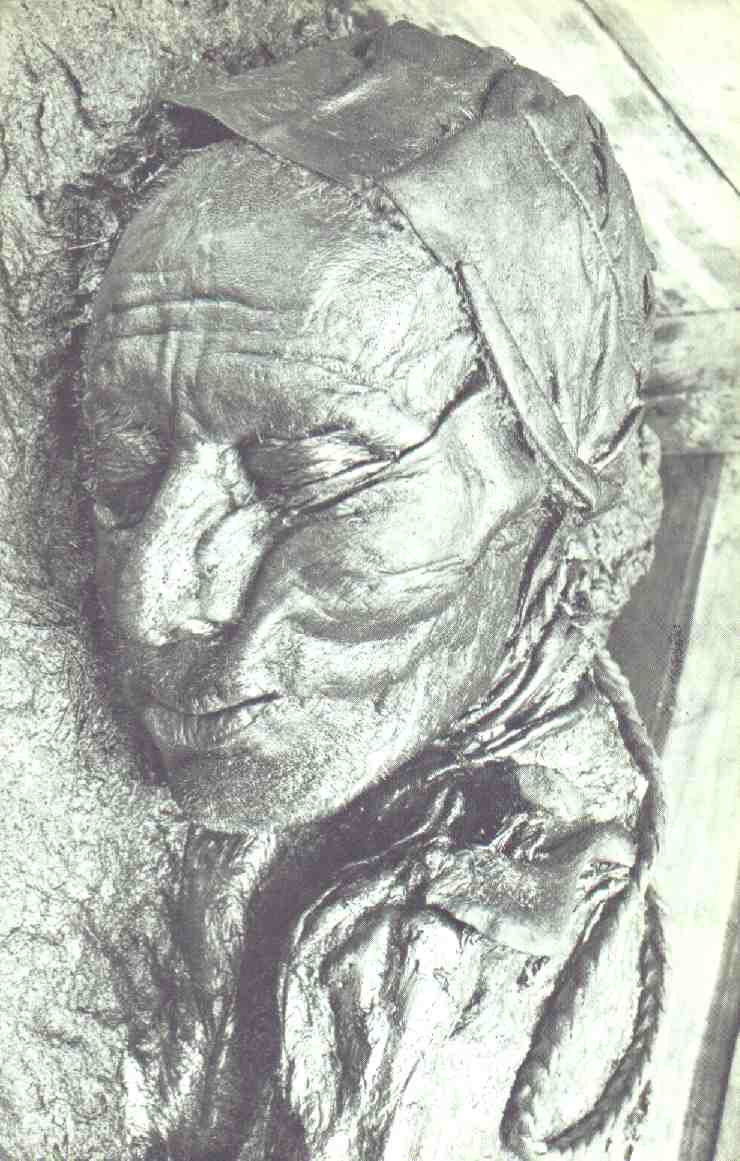
But in dismissing Heaney’s engagement with The Bog People as a matter of “convenience,” do Lloyd and company actually underestimate—or fail entirely to understand—the very manner in which, as Heaney explains in his interview with Randall, the images in Glob’s book were “a revelation” to him not just as poet but as person? I think so, especially in light of the extent to which Heaney’s initial response to the photographs in Glob’s book might be understood in terms articulated by philosopher and cultural critic Roland Barthes in his book Camera Lucida: Reflections on Photography. Iconoclastic when first published in French in 1980, Barthes’ study has become iconic, and his terms studium and punctum, used to describe how certain photographs catch the eye of the viewer, have become widely accepted in photography circles.

In fact, Heaney’s account in the Ploughshares interview of how he was captivated specifically by the first photo in the book, a close-up of the head of the Tollund Man, resonates fully with Barthes’ defining of punctum as an element of a photograph that “rises from the scene, shoots out of it like an arrow, and pierces me.” (In contrast, a photograph’s studium involves simply the basic subject matter, not the impact of the image on an individual viewer.) Remarking how the head of the Tollund Man “has had an enormous effect on anybody who ever looked at it,” Heaney admits outright the poignant connection he felt with the shriveled but remarkably well-preserved two thousand-year-old figure excavated from the Danish bog: “The Tollund Man seemed to me like an ancestor almost, one of my old uncles, one of those mustached archaic faces you used to see all over the Irish countryside. I just felt very close to this.”

That is not to say that Heaney’s discovery of The Bog People was pure accident: no doubt he was drawn to Glob’s book by his deep-rooted fascination with his native Irish bog—his “genuine obsession,” as he put it to interviewer Randall—whose sensuous mystery he had expressed in “Bogland,” the concluding poem of his volume Door Into the Dark, in 1969: “The wet centre is bottomless.” But his turning the page to the photograph of the Tollund Man seems truly to have involved what Roland Barthes calls “that accident which pricks me (but also bruises me, is poignant to me).” Recalling his initial response to the images in The Bog People, Heaney tells interviewer James Randall: “This wasn’t thought out. It began with a genuinely magnetic, almost entranced, relationship with those heads.” Indeed, a first line of defense against charges that Heaney’s “bog poems” were part of some cynically conceived program proffering the “pap” of “aesthetic resolution” to his “dispossessed” readers might be the fact that his punctum-prompted poem “The Tollund Man” was included utterly inconspicuously in the middle of his volume Wintering Out (1972).

In an interview with Seamus Deane in 1977, Heaney described how the poems in North “arose out of a necessity to shape and give palpable linguistic form” to the “urgency” he felt regarding Northern Ireland’s political complexity in the mid-1970s. Inspired (or “wounded,” as Barthes would say) by the literal lens that preserved on film the bodies preserved in the Scandinavian bogs, Heaney offered in his poems not a “resolution”—aesthetic or otherwise—to that complexity but rather an alternative lens (as it were) through which his readers might view its “religious intensity”: this was the lens of poetic “ulteriority”—of “saying one thing in terms of another.”

Monday, June 1, 2009

PLAYING NOW: RODDY DOYLE'S "NEW BOY"

This piece first appeared in The Boston Irish Reporter, Volume 20, Number 6 (June 2009), p. 10.

The so-called Celtic Tiger, a period of unprecedented economic prosperity in Ireland, seems now to have lost much of its bite. But its teeth marks—at least in the form of unprecedented social changes underwritten in large part by that prosperity—appear to be deeply permanent, and the title story of Roddy Doyle’s collection The Deportees (2007) provides one gauge of the transformation that occurred in Ireland during the Tiger's two-decade flourishing. Bringing back to literary life the character of Jimmy Rabbitte, Jr., the protagonist of Doyle’s first novel, The Commitments (1987), “The Deportees” is a sequel (of sorts) in that Jimmy, now married and with three children (a fourth arrives in the course of the story), still harbors the dream of managing a commercially successful group of Irish musicians.

In The Commitments, the band he organized performed American “soul music”—the songs of Otis Redding and James Brown and Aretha Franklin and Wilson Pickett—under the premise articulated by Jimmy to the band members this way in the 1991 adaptation of the novel to the big screen, directed by Alan Parker: “Do you not get it, lads? The Irish are the blacks of Europe. And Dubliners are the blacks of Ireland. And the northside Dubliners are the blacks of Dublin. So say it once, say it loud—I’m black and I’m proud.” In “The Deportees” Jimmy assembles an even more motley crew to perform the music mostly of Woody Guthrie, the so-called “dustbowl troubadour” whose songs both record and represent a substantial swatch of the historical fabric of depression-era American life. Besides the music they perform, the most conspicuous difference between Jimmy’s two bands is the ethnic makeup. Reflecting on the radical change that mass immigration from continental Europe, from Africa, and beyond brought to Ireland by the mid-1990s, Roddy Doyle writes in his Foreword to The Deportees: “I went to bed in one country and woke up in a different one.” This is the country that Jimmy Rabbitte finds himself in two decades after the heyday of The Commitments when, bumped into and knocked over by a young Romanian on Parnell Street, then run over by an Italian bicycle courier, he experiences an epiphany that even the ultra-cosmopolitan James Joyce would have had trouble imagining exactly a century earlier. Helped to his feet by the Romanian lad and by an African woman, he realizes that his new band must literally embody Dublin’s new multi-ethnic demographic: “Jimmy’s head was hopping as he stood up. . . . But he was grinning. Jimmy had his group.”

Detailing the evolving dynamic—both musical and interpersonal—of The Deportees, the rest of the story reads as a sort of parable of multicultural co-existence in latter-day Dublin. Indeed, comprising an imposing lead singer from Africa named King Robert, a drummer from Moscow, a young woman guitarist from America, a djembe drummer from Nigeria, a woman singer from Spain, a Romanian father and son on accordion and trumpet respectively, a guitarist from Roscommon, a female survivor (still purple-haired) of Dublin’s punk scene of the late 1970s on bass, and sixty-year-old traveler Paddy Ward as an additional lead singer, the makeup of the band is fraught with tensions, suspicions and the potential for profound intercultural misunderstandings. But with Guthrie’s music of social conscience, and of social consequence, as their common denominator, The Deportees transcend their differences to emblematize—clearly—Roddy Doyle’s vision for a harmonious new Dublin.

In fact, that vision is the common denominator for the eight stories that constitute the collection, though it may be expressed most powerfully in the one titled “New Boy.” As its universally familiar title hints, this story is about a “new boy,” a black African immigrant named Joseph, on his first day in a classroom of fellow nine-year-olds. Immediately targeted for abuse by young hooligans Christian Kelly and Seth Quinn, Joseph has to learn how to interpret and to negotiate the social codes that operate in this microcosm of Dublin itself. Carrying, unbeknownst to his classmates, the emotional baggage of earlier childhood trauma in his war-torn native country (unnamed in the story), Joseph proves altogether capable of handling both the verbal and the physical bullying inflicted on him: his unruffled response to Christian and Seth actually ruffles them to the point that they come around to forming what would have seemed at first an unlikely alliance with the “new boy.” Constructed partly in opposition to the nosy classroom know-it-all Hazel O’Hara and partly in opposition to their well-intentioned but mostly ineffectual teacher (whose last name Joseph never catches), this alliance reinforces in comic fashion Doyle’s serious belief in Dublin’s—and Ireland’s—multicultural future.

Well, actually Dublin’s multicultural present, for in his typically witty fashion Doyle has the ultimate bond between Joseph and his tormentors hinge on their joint recognition of their teacher’s incessant repetition of the word “now.” Putting into the teacher’s mouth every imaginable variation on the word’s grammatical versatility—from a tut-tutting “Now now” to a general alert that there is schoolwork to be done to a stern warning regarding unacceptable classroom behavior—Doyle reminds his readers through the teacher’s unconscious verbal tic (in the course of the narrative she says the word at least twenty-eight times, with almost as many different inflections) that this story does represent Dublin now: that the city has changed utterly and irreversibly and that the entire populace must adjust and adapt and individuals must accordingly learn not only tolerance for but also generous acceptance of the “otherness” of others.

Aptly, then, the adaptation of “New Boy” as a short film by Irish-American writer and director Steph Green has been added to the roster of films available for free online viewing at the Responsibility Project website sponsored by Liberty Mutual Insurance Company as a spin-off of their publicly acclaimed series of “pay-it-forward” television commercials. The website explains: “We thought, if one TV spot can get people thinking and talking about responsibility, imagine what could happen if we went a step further? So we created a series of short films, and this website, as an exploration of what it means to do the right thing.” In an interview on the popentertainment.com website, Green explains how Doyle’s story first appealed to her: “It’s really interesting the degree to which we are strangers—and not strangers. What does it mean to have to sit next to someone? That’s the same in a classroom as on the bus. There is something about the humanity of that which I like looking at.” Starring Olutunji Ebun-Cole as Joseph, Norma Sheahan as the teacher, Simon O’Driscoll as Christian, Fionn O’Shea as Seth, and Sinead Maguire as Hazel, the adaptation was nominated for an Oscar in 2009 in the short film category. Just eleven minutes long, the film of “New Boy” can be viewed via YouTube.

Friday, May 1, 2009

McWILLIAMS AND FALLON: NEWS OF THE WORLD

This piece first appeared in The Boston Irish Reporter, Volume 20, Number 5 (May 2009), p. 18.

The economic news out of Ireland may be even more grim than elsewhere in the world. The government itself may be in danger of international bankruptcy. On a much smaller but no less urgent scale, after a giddy decade-and-a-half of riding high on the back of the so-called Celtic Tiger, literally countless individuals who have enjoyed prosperity beyond all imagining may be peering over the precipice of financial ruin. The higher the perch the harder the fall.

More an observer than a prophet, Irish economist David McWilliams began to chronicle both the lustrous coat of the Celtic Tiger and its dark underbelly in his book The Pope’s Children: Ireland’s New Elite, published in 2005. Both entertaining and enlightening, its mostly sardonic tone echoing the work of American political and cultural commentator David Brooks (especially his book Bobos in Paradise: The New Upper Class and How They Got There), McWilliams’ book dates the turning point in Ireland’s “fortunes”—not so immediately economic as social and cultural—to the visit to the country by Pope John Paul II in 1979. Or perhaps that was the tipping point—the high-water mark of the country’s maintaining at least a nodding recognition of its traditional rural and Catholic self-identity (and accompanying “values”) before the emergence of several dominant new breeds of Irish men and women from the post-Papal floodplain of affluence generated by Ireland’s membership in the European Union.

McWilliams labels one of these emergent breeds “HiCos” (or Hibernian Cosmopolitans): the urban and urbane hybrid survivors of the war between diehard “Hibernians” on the far right wing and free-living “Cosmopolitans” on the far left who fought their battles over abortion, divorce, and immigration during the 1980s and ’90s. In 2005, McWilliams could optimistically posit these suave HiCos—with one foot rooted in the “traditional” camp and the other foot firmly placed “forward”—as the hope for the country’s future, the antidote to the bleak and cynical view of contemporary Ireland projected by the popular mass media, whom he labels the “Commentariat.” McWilliams’ optimism may be considerably diminished now, in light of Ireland’s particularly dire straits relative to the worldwide economic crisis: the future for the HiCos may be as uncertain as the future of the entire country.

Even more dire, however, may be the plight of another of McWilliams’ new breeds, the Decklanders—his name for Ireland’s rapidly increasing suburban population that during the glory years of the Celtic Tiger spread further and further out from Dublin and other city centers into housing estates with newly-constructed homes complete with every modern amenity . . . including American-style back decks. Focusing particularly on a subset that he labels “The Kells Angels,” McWilliams sketches their world thus: “they live in the outer suburbs, clustered around former market towns. For example Kells, Drogheda, Tullamore, Kildare, Naas or Gorey on the east coast, places like Watergrass Hill, Midleton, Carrigaline and Ballincollig around Cork, and towns such as Loughrea, Claregalway, Tuam and Barna in Galway. These are Ireland’s new suburbs and they will be the most vibrant part of the country by 2020, but today they are dormitories which empty out in the morning and fill up again in the evening. The great Irish suburban movie—Irish Beauty—when it is eventually made, will be based here starring an ageing Colin Farrell as a lecherous bank official going through a mid-life crisis.”

Well-educated and gainfully employed in cities as much as a ninety-minute bumper-to-bumper drive away from where they yawn and stretch at dawn and bed down at night, these Kells Angels—their long morning and afternoon commutes distancing them both literally and figuratively from the HiCos heart of Irish matters—may ultimately suffer the hardest fall as a result of Ireland’s drastic economic downturn. And then what?

Who knows? But McWilliams’ book seems to have proven inadvertently prophetic in observing the predicament of this substantial segment of the Irish populace living not only “beyond the Pale” but also beyond their financial means, racking up massive personal debt while relentlessly pursuing the never-ending materialistic dreams of the “Expectocracy”—a society in which everyone is middle-class and wanting to “trade up”: “I want the biggest fridge, the best holiday, the newest car, the loudest sound system, the healthiest food, the best yoga posture . . .”

In this respect, the “Kells” that McWilliams projects in The Pope’s Children could hardly be farther from the territory that poet Peter Fallon inscribed in “The Lost Field” more than a quarter-century ago . . . almost a decade before the Celtic Tiger came roaring into being. Read literally, Fallon’s poem is about a common-enough phenomenon in the through-other world of rural Irish property boundaries and deeds—a purchase-and-sale agreement for a parcel of land that may or may not exist: “Somewhere near Kells in County Meath / a field is lost, neglected, let by common law.” Bought from the hard-drinking and hard-nosed Horse Tobin, this unaccounted-for piece of outlying real estate has potentially costly ramifications for Fallon’s small-farming relatives who paid for it in good faith. For Fallon himself, committed to taking over the family farm in the townland of Loughcrew after returning home to Oldcastle from studying at Trinity College Dublin (“I think it exquisite,” he wrote in the title poem of his 1983 volume Winter Work, “to stand in the yard, my feet on the ground, / in cowshit and horseshit and sheepshit”), that missing plot of land is as much emblematic as actual: “My part in this is reverence.”

Originally included in Winter Work and reprinted in News of the World (Fallon’s selected poems published in both American and Irish editions, in 1993 and 1998 respectively), “The Lost Field” clearly expresses a valuing of property of a much different order than McWilliams’ “Kells Angels” would seem capable of by the turn of the new century. For Fallon, ownership is not mere material acquisitiveness but a sacred trust involving a relationship between person and place that has little connection to financial investment or commercial worth:

Thinks of all that lasts. Think of land.
The things you could do with a field.
Plough, pasture, or re-claim. The stones
you’d pick, the house you’d build.

Don’t mind the kind of land,
a mess of nettles even,
for only good land will grow nettles.
I knew a man shy from a farm
who couldn’t find a weed
to tie the pony to.

Looking to settle down not to trade up, seeking permanence not instant gratification, Peter Fallon plainly subscribes to certain “values” that, according to David McWilliams’ view of Ireland as the indiscriminately omnivorous Celtic Tiger, would soon become as lost to the Irish “Expectocratic” sensibility as that rumored “lost field” itself. “Imagine the world / the place your own windfall could fall,” Fallon writes, transforming the literal plot of land into an abstraction, an idea . . . or an ideal of unassuming and therefore, perhaps, more contented and more fulfilling living. Committing himself to the small world of Kells and environs, Fallon concludes his poem: “I’m out to find that field, to make it mine.” Is it too late for any of McWilliams’ Kells Angels to stake a similar modest claim?

Wednesday, April 1, 2009

SEAMUS HEANEY'S "FUNERAL RITES" AND JAMIE O'NEILL'S "FORGIVENESS"

This piece first appeared in The Boston Irish Reporter, Volume 20, Number 4 (April 2009), pp. 16, 19.

Published in his landmark volume North (1975), Seamus Heaney’s poem “Funeral Rites” endures as a richly evocative contemplation of the sectarian violence that came to define life in his native Northern Ireland for the better part of three decades beginning in 1969. Included in part I of the volume, the poem is one of a series of poems mostly inspired by Heaney’s discovery of P. V. Glob’s book The Bog People (coincidentally published in English translation in 1969), a fascinating anthropological study of bodies buried in the bogs of northern Europe during the Iron Age and only recently unearthed, remarkably preserved, after several millennia.

Reflecting in his essay “Feeling Into Words” (1974) on Glob’s conclusion that many of these bodies “were ritual sacrifices to the Mother Goddess, the goddess of the ground who needed new bridegrooms each winter to bed with her in her sacred place, in the bog, to ensure the renewal and fertility of the territory in the spring,” Heaney recognized that “the religious intensity of the violence” in Northern Ireland needs to be understood not just in terms of the traditional social, economic, and political Catholic-Protestant sectarian divide in that province. Rather, it must be considered in terms of a truly archetypal “struggle between the cults and devotees of a god and a goddess”—the emblematically male crown of England, and Ireland conventionally feminized as “Mother Ireland, Kathleen Ni Houlihan, the poor old woman, the Shan Van Vocht, whatever . . .”

Heaney’s first foray into the rich territory opened up by Glob’s book was “The Tollund Man” (published in his volume Wintering Out in 1972), which begins with the poet promising himself that he will go on pilgrimage to see in person the most famous of the bog bodies:

Some day I will go to Aarhus
To see his peat-brown head,
The mild pods of his eye-lids,
His pointed skin cap.

The Danish city of Aarhus sounding as a homonym for “our house,” Heaney concludes the poem on a note of cold comfort indeed:

Out there in Jutland
In the old man-killing parishes
I will feel lost,
Unhappy and at home.

“Funeral Rites” thus represents a further example of what Heaney described as his poet’s “search for images and symbols adequate to our predicament”—a search that he framed by way of touchstones lifted from William Shakespeare (Sonnet 65) and W. B. Yeats (“Meditations in Time of Civil War”): “The question, as ever, is ‘How with this rage shall beauty hold a plea?’ And my answer is, ‘by offering befitting emblems of adversity.’”

Comprising three sections, each one in turn comprising eight, seven, and five slim unrhymed quatrains, the poem actually sits on the page as a visual emblem of Heaney’s overall poetic enterprise, which he described metaphorically in “Digging,” the opening poem of his first volume, Death of a Naturalist (1966):

Between my finger and my thumb
The squat pen rests.
I’ll dig with it.

Coaxing the reader’s eye to scroll deeper and deeper down the page (“down and down / For the good turf”), “Funeral Rites” also takes the reader into darker and darker thematic ground belied by the relative innocence of the opening section, which begins innocuously enough: “I shouldered a kind of manhood / stepping in to lift the coffins / of dead relations.” For even while describing the common rite of passage into Irish male adulthood which involves attending wakes and serving as pall bearer at funerals, Heaney employs diction (“soapstone,” “igloo,” “glacier”) that resonates with a far-northern “word-hoard” (as he puts it in the title poem of North) that evokes not only Glob’s Scandinavian world but also the history and the legacy of the brutal Viking invasions of Ireland which began in the late 8th century and continued until the Battle of Clontarf in 1014:

Dear soapstone masks,
kissing their igloo brows
had to suffice

before the nails were sunk
and the black glacier
of each funeral
pushed away.

The auspiciousness of his word-choices notwithstanding, the second section of the poem actually goes back even further historically than the Viking invasions in search of “befitting emblems of adversity” as the local funerals become more numerous and their causes more nefarious with the explosion of sectarian violence in the North in the 1970s:

Now as news comes in
of each neighbourly murder
we pine for ceremony,
customary rhythms:

the temperate footsteps
of a cortège, winding past
each blinded home.

As telling as John Milton’s oxymoron “darkness visible” (describing Hell in Paradise Lost), that self-contradicting phrase “neighbourly murder” leads by way of the words “ceremony” and “customary” to an allusion to Yeats’s great poem “A Prayer for My Daughter” (1919), in which the poet asks: “How but in custom and in ceremony / Are innocence and beauty born?” The custom and the ceremony that Heaney imagines in his time and place involves the “black glacier” of the funeral, now transformed into “a serpent,” being steered south of the border through “the Gap of the North” (the Moyry Pass, the route running out of south Armagh toward Dundalk) and on to “the great chambers of Boyne”—the series of 5000-year-old passage graves (most famously Newgrange, Knowth, and Dowth) that dot the Boyne Valley in counties Louth and Meath. Invoking for the alert reader both the Battle of Moyry Pass (1600) and the Battle of the Boyne (1690), the very course of the imagined funeral procession is marked by milestones of Ireland’s violent history that must be laid to rest.

In the third section of “Funeral Rites,” the insidious serpent of violence sealed inside the passage grave by a massive stone, Heaney imagines the procession returning to Northern Ireland “past Carling and Strang fjords” (placenames reflecting the Viking legacy in Ireland), “the cud of memory / allayed for once, arbitration / of the feud placated.” Then, imagining the spirits dwelling with equanimity in that Irish burial mound, Heaney finally—directly licensed by the Nordic resonance of Glob’s book—inserts into his poem the spirit of Gunnar, a hero from the Icelandic Volsunga Saga, “who lay beautiful / inside his burial mound, / though dead by violence // and unavenged”: though slain by the mother of his enemy Atli, in Heaney’s interpretation Gunnar yet rests in peace because the cycle of violence ends with his death. Obviously, Heaney’s art of digging in this poem leads to parable-like implications regarding reconciliation and forgiveness between the “cults and devotees” in Northern Ireland.

And that is why I thought of that poem in all its richness and density when I recently viewed a very short film (8 minutes, 58 seconds) titled Forgiveness, scripted by Jamie O’Neill, best-known as the author of that remarkable novel of the Great War and the Easter Rising, At Swim, Two Boys (2001). The film links three historical figures: British-born diehard Irish nationalist Erskine Childers, executed by an Irish Free State firing squad in 1922; his son Erskine, who served briefly (1973-74) as President of the Republic of Ireland; and Kevin O’Higgins, Minister of Justice in the Free State and one of the men who had signed the execution order for the elder Childers. Not wanting to play “spoiler,” I will mention only that the film is premised on the anecdote that Childers requested of his 16-year-old son that he seek out and shake the hand of every man who had signed his death warrant. While the film speaks to a different time and place than Heaney’s poem, it nonetheless shares the poem’s concluding vision of hopefulness. Understated rhetorically and directed and acted with elegant simplicity, Forgiveness can be viewed for free on Jamie O’Neill’s website.